Hare Cheese: Why a Meat Dish Was Called Cheese
What hare cheese meant in Molokhovets in 1901: two numbers for one recipe, a pâté-like texture, truffles and other historical cheeses.
Hare cheese is one of the most surprising titles in A Gift to Young Housewives. It is neither cheese from hare milk nor an old name for ordinary curd cheese. The recipe describes a baked mixture of minced hare, eggs, butter, grated cheese and spices, cooled and cut into slices. Why was it called cheese?
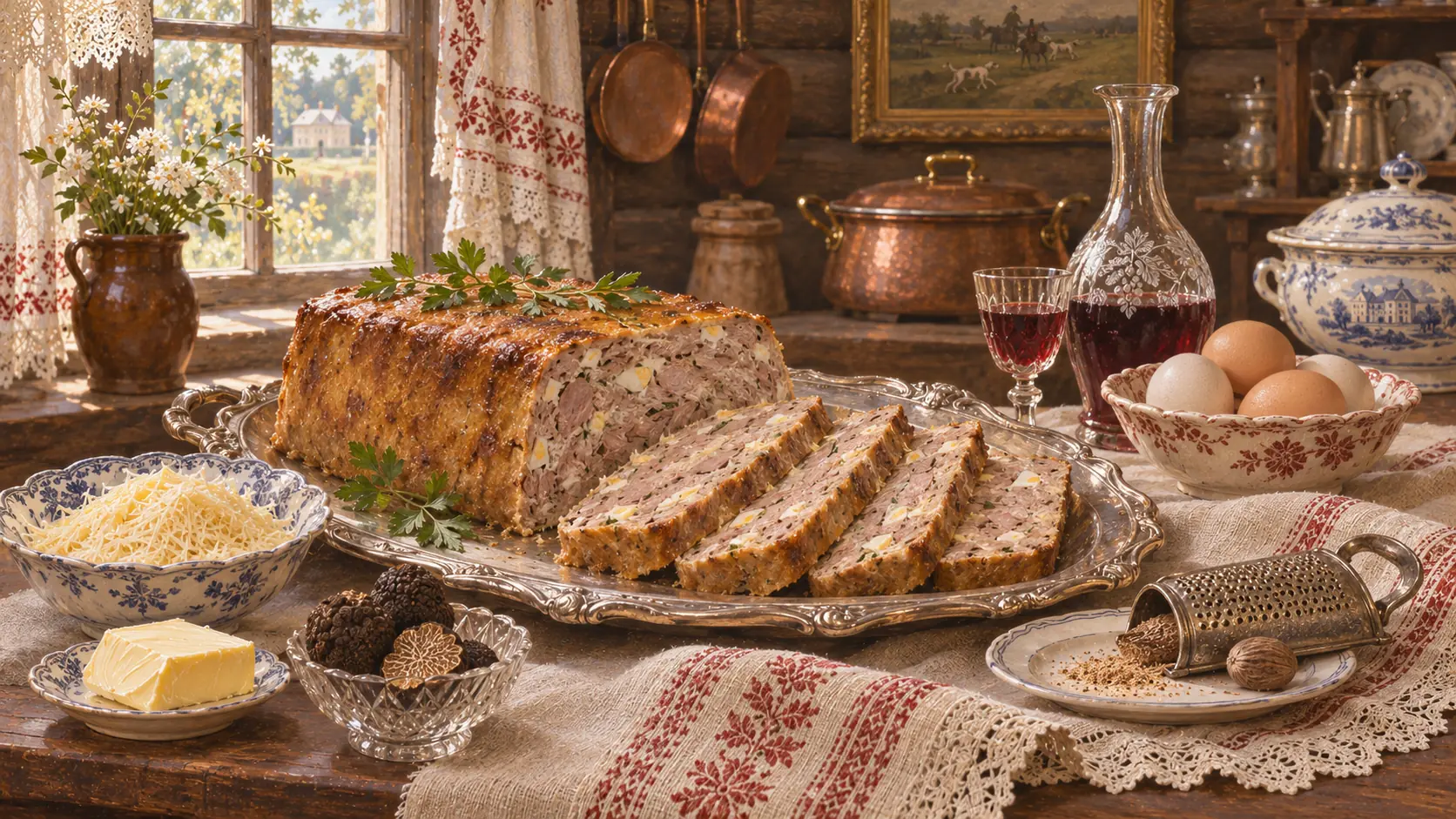
Start with the original: No. 993, Hare Cheese for Breakfast, and No. 3662, Hare Cheese. The available texts coincide; the first is among meat dishes, the second in the dairy section. Both records are preserved, and the reason for the repetition remains unknown.
What was inside hare cheese
In No. 993 the hare is first fried and then braised until tender. Meat is removed from the bones, finely chopped and combined with a preparation of five fried eggs, butter, grated cheese, nutmeg, stock, wine and truffles.
The mixture is pounded, sieved, put into a greased mould sprinkled with cheese, baked, cooled and sliced. The final sequence is important: the dish needs enough cohesion to be sliced. It is not a product of dairy cheesemaking, because cooked meat is the main base.
A useful modern analogy is a firm baked meat mixture resembling certain pâtés in its serving method. This describes the form without equating the historical recipe with any particular modern pâté.
Why cheese did not define the composition
Searching only for the word cheese is misleading. Section XLVIII includes homemade curd cheese No. 3648, Swiss-style rennet cheese No. 3651 and mushroom cheese No. 3656, combining mushrooms, calf's liver and butter. Several product groups share a name.
A culinary heading could indicate similarity in firmness, appearance or serving rather than exclusively dairy origin. But without additional historical dictionary evidence we cannot assert that every nineteenth-century dish called cheese was named for texture. The observation rests on particular ingredients and methods, not a universal definition.
The related study of milk and cheesemaking examines actual dairy products, helping distinguish them from meat appetizers.
One recipe in two places
No. 993 is in Section VII among beef, pork and hare dishes, near roast hare No. 990 and hare sausages No. 992. That context classifies it mainly by raw ingredient.
No. 3662 appears among butter, cheese, milk, cream and eggs, next to green cheese and cheese or butter made from game No. 3663. This suggests classification could also reflect the finished product's form or serving method.
The digital preparation and ingredient lists coincide. Whether this was deliberate cross-publication, inherited from earlier editions or another editorial decision remains uncertain. The printed pages and edition history require comparison. Both numbers and locations should be retained.
Hare cheese for breakfast in an earlier edition
The accessible table of contents of the 1861 edition contains No. 648, Hare Cheese for Breakfast, near cold pâtés and other meat and game dishes. This confirms that the name was not new in 1901. A contents entry does not establish that every edition used identical proportions and wording.
The title also existed outside Molokhovets: a bibliographical description of the second edition of Pelageya Alexandrova-Ignatieva's Practical Foundations of the Culinary Art (1902) mentions hare cheese among its recipes. This does not prove that both authors prepared it identically, but establishes a wider use of the name.
Hare, hazel grouse and truffles: an elaborate cold appetizer
No. 3662 contains wine, nutmeg, grated cheese and truffles, contributing to flavour and a firm mixture served after cooling. These indicate an elaborate recipe, but cost and actual consumers cannot be calculated without price and household records.
The next entry, No. 3663, Cheese or Butter from Game, uses hazel grouse, butter and optional Parmesan, sieved and placed in a butter dish. A similar recipe No. 3633, Hazel Grouse Butter for Breakfast or Evening Tea, appears in the same section. Cheese and butter can refer to prepared appetizer mixtures rather than only their dairy ingredients.
These entries illuminate serving culture: a cold prepared mixture that could be sliced or spread, not just a piece of roast meat. Such conclusions follow from the verbs and ingredients, not an invented historical dinner scene.
How to read the recipe today
The researcher is interested in the old word, the dish's construction and editorial history. The 1901 entry does not establish safe meat temperatures, cooling conditions or storage times, and covering food with fat is not a substitute for modern food-handling rules.
Hare cheese is a historical document rather than a modern technical recipe. The library preserves Molokhovets's words and explains them separately so the reader need not mistake the unusual name for a modern dairy product.
A name as a small window into the past
Two numbers in one book, meat beside grated cheese, a cooled baked mixture and neighboring game butters explain why one old line raises so many questions.
There is no need to invent a legend about hare milk or an allegedly forgotten single variety of cheese. The title denotes a specific dish with a recorded method.
The story exemplifies the digital library's principle: preserve the original, distinguish historical meanings and connect recipes across sections without erasing the features of the 1901 edition. The study of winter game trade offers further context.
Original recipes and historical sources
Elena Molokhovets, A Gift to Young Housewives, 1901 edition. Original source links are retained below.
- No. 993 — Breakfast Hare 'Cheese' (Baked Savoury Loaf) · Russian original
- No. 3662 — Hare Cheese (Baked Meat Terrine) · Russian original
- Section XLVIII: Butter, cheese, milk and eggs (in Russian)
- No. 3648 — Homemade White Cheese from Tvorog and Sour Cream · Russian original
- No. 3651 — Swiss-Style Cheese · Russian original
- No. 3656 — Champignon Mushroom Cheese Spread · Russian original
- No. 990 — Roast Hare with Liver Gravy · Russian original
- No. 992 — Sausages Made from Hare · Russian original
- No. 3663 — Game Cheese or Butter · Russian original
- Contents of Molokhovets's 1861 edition, No. 648
- Bibliographical description of Alexandrova-Ignatieva's cookbook, second edition (1902)
- No. 3633 — Hazel-Grouse Butter for Breakfast or Evening Tea · Russian original
Related reading
Historical recipe, not safety guidance. Game and meat preparation, cooling, storage and treatment of raw ingredients reflect historical practice. Modern food-safety requirements apply to practical preparation.