Green Walnut Preserves: Why the Syrup Was Reduced Separately
Recipe No. 3405 from 1901: unripe walnuts, cinnamon, cloves and successive thickening of sugar syrup.
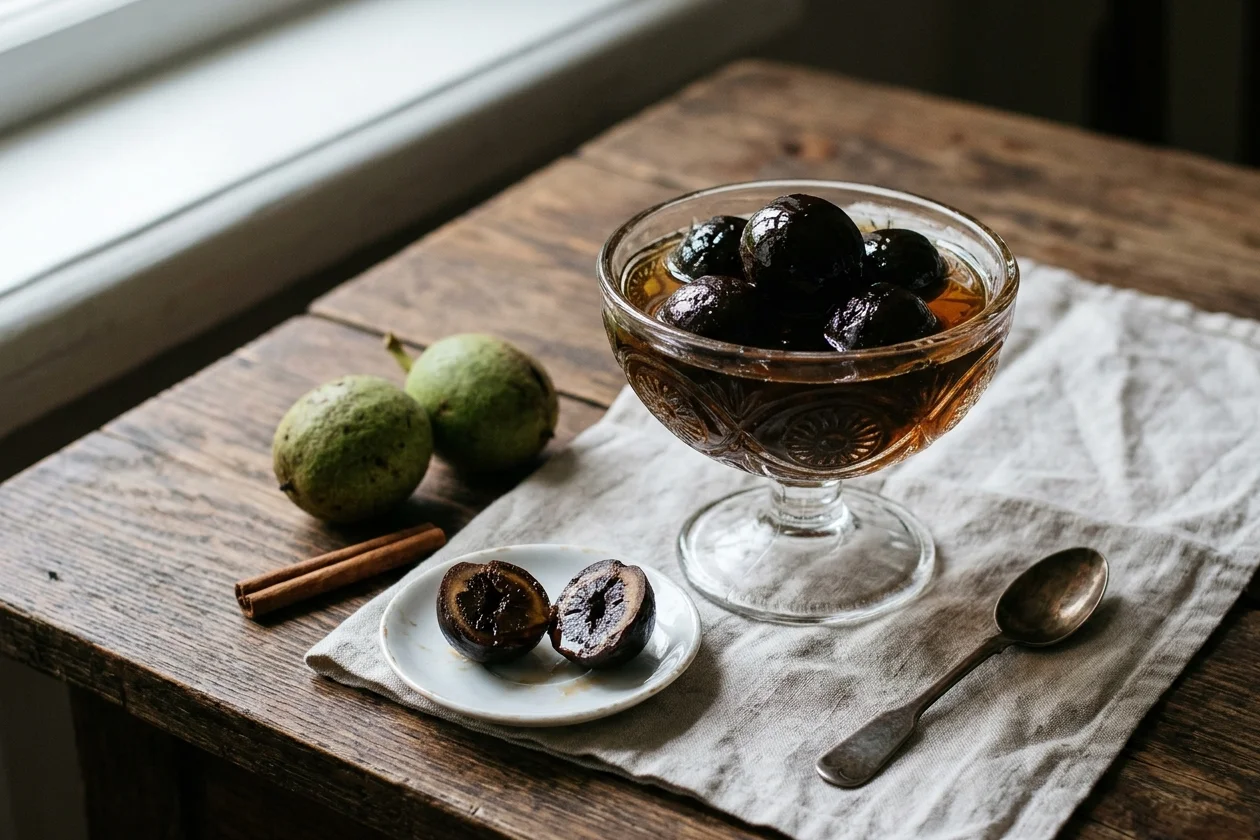
Why the walnuts had to be green
In No. 3405, Elena Molokhovets makes preserves not from ordinary dry shelled kernels but from green walnuts. The text does not call for removing the kernel: whole fruit is treated and pierced with a wooden skewer. Its immaturity makes this possible. The hard shell of a mature walnut would prevent a soft whole fruit from being obtained. The degree of maturity is not expressed as a date or measurable criterion, so a universal harvest date cannot be established from the recipe alone.
How softness was assessed
Preliminary treatment involved prolonged soaking in soft water followed by boiling. At this stage readiness was tested with a wooden skewer, which had to pass through the fruit. This is a household test based on resistance of the tissue rather than a thermometer. The source does not explain whether the soaking water was changed, the room temperature or changes in walnut composition. A safe modern preserving technique cannot be derived from this description without further validation.
Two pounds of sugar for one pound of walnuts
Molokhovets specifies twice the weight of prepared walnuts in sugar. One historical Russian pound is approximately 409.5 grams, but the recipe is easier to understand as a mass ratio of one to two. Not all the sugar is used at once: syrup begins with half the quantity, and the other half is added later. Cinnamon and cloves are present at the first pouring. This separates the initial saturation of fruit with syrup from its final concentration.
Why the syrup was separated repeatedly
The author specifies three pourings. Between them the walnuts are placed on a sieve and the separated syrup heated again: first with the remaining sugar, then until sufficiently thick. Water from the fruit may pass into the syrup, altering concentration. Reheating the liquid without fruit allows separate reduction. This is a plausible explanation of the operation, but Molokhovets neither measures sugar concentration nor explains it scientifically. Repeated treatment of syrup must not be confused with making three entirely new batches of liquid.
Comparison with neighboring preserves
Nearby are apple preserves resembling pineapple, No. 3403, and melon preserves, No. 3404. Sliced fruit is covered with an equal weight of sugar and processed in a vessel. Walnut preserves differ: the denser whole fruit is first softened and syrup concentration gradually increased. The juxtaposition emphasizes varied techniques, not a universal formula for sweet stores. Their place in one section does not make storage methods interchangeable.
How to picture the historical preserves today
Molokhovets does not describe the finished walnut colour, taste or precise syrup thickness. An image of dark whole fruit in a glass dish is therefore an artistic reconstruction, not a documentary specimen. The historical method of covering a jar with an animal bladder does not establish modern safety: validated processing and storage conditions are necessary. The entry's value lies in unusual ingredients and staged syrup preparation rather than literal repetition of a multi-day process.
Original recipes and sources
Elena Molokhovets, A Gift to Young Housewives, 1901 edition. Links to scans are available on the original Russian recipe pages.