Ginger Preserves from Watermelon Rind: How Molokhovets Imitated an Imported Sweet
What 'artificial' meant in No. 3290 and why young lettuce stalks were also made into ginger preserves.
Why the preserves were called artificial
No. 3290 is entitled Artificial Ginger Preserves from Watermelon Rind. Today artificial may suggest synthetic additives, but here something else is happening: ordinary plant material acquires its flavour through treatment with genuine ginger. Neighboring No. 3291 explicitly says that lettuce-stalk preserves will resemble imported ginger preserves. Together these entries demonstrate culinary imitation, the creation of a similar product from a different base. They offer no reason to regard the historical sweet as a chemical counterfeit.
Which part of the watermelon was used
In No. 3290, the author removes the outer green skin and uses the remaining rind. This distinguishes it from a dessert made from juicy red flesh. Inner rind can retain its shape after preparation and absorb syrup. The recipe specifies no exact colour, size or translucency of the pieces. A reconstruction may show pale slices, but cannot claim their appearance is documented. No. 3289 also describes treating watermelon after removing the outer skin, but uses lemon rather than ginger.
How ginger aroma was imparted
According to the historical account, the prepared rind first comes into contact with crushed ginger, which is subsequently washed away before sugar syrup is used. This differs from simply putting pieces of ginger root into a jar. The author separates flavouring from the final sweet treatment. Some aromatic substances may have remained in the plant tissue, but their quantity and flavour intensity are unknown. The timing and conditions of the old process should not be transferred to home preserving without validation.
Lettuce preserves: an even more unusual version
No. 3291 calls for young, thick lettuce stalks that are brittle rather than woody. They are treated with ginger and then prepared with sugar. Unlike the watermelon entry, this version also includes a piece of whole ginger root in the syrup, which is later removed. This detail shows that the author deliberately sought a particular aroma. Lettuce here denotes the plant, not a prepared mixed salad. The leaves are not named as the base of the preserve.
Comparison with ordinary watermelon preserves
No. 3289 uses lemon juice and sugar flavoured with zest. This distinguishes the ginger version from the more general technique of processing watermelon. No. 3290 specifies a glass of fine sugar for a glass of prepared rind, whereas No. 3289 determines sugar by weight. Volume and weight measures are not interchangeable without further information about density and moisture. The comparison should emphasize how the author expressed proportions, rather than convert them into a single modern formula.
Imitation as a culinary approach
A similar principle appears in No. 3288, where a shortage of pineapples is addressed by replacing part of the fruit with apples that retain their shape during processing. Molokhovets explicitly explains that the preserves will resemble genuine pineapple preserves. These entries do not establish that householders always substituted ingredients purely to save money: availability and desired taste may also have mattered. But the text confirms the idea of replacing a base while retaining a characteristic association, an interesting feature of historical recipe language.
Why historical storage times cannot be transferred
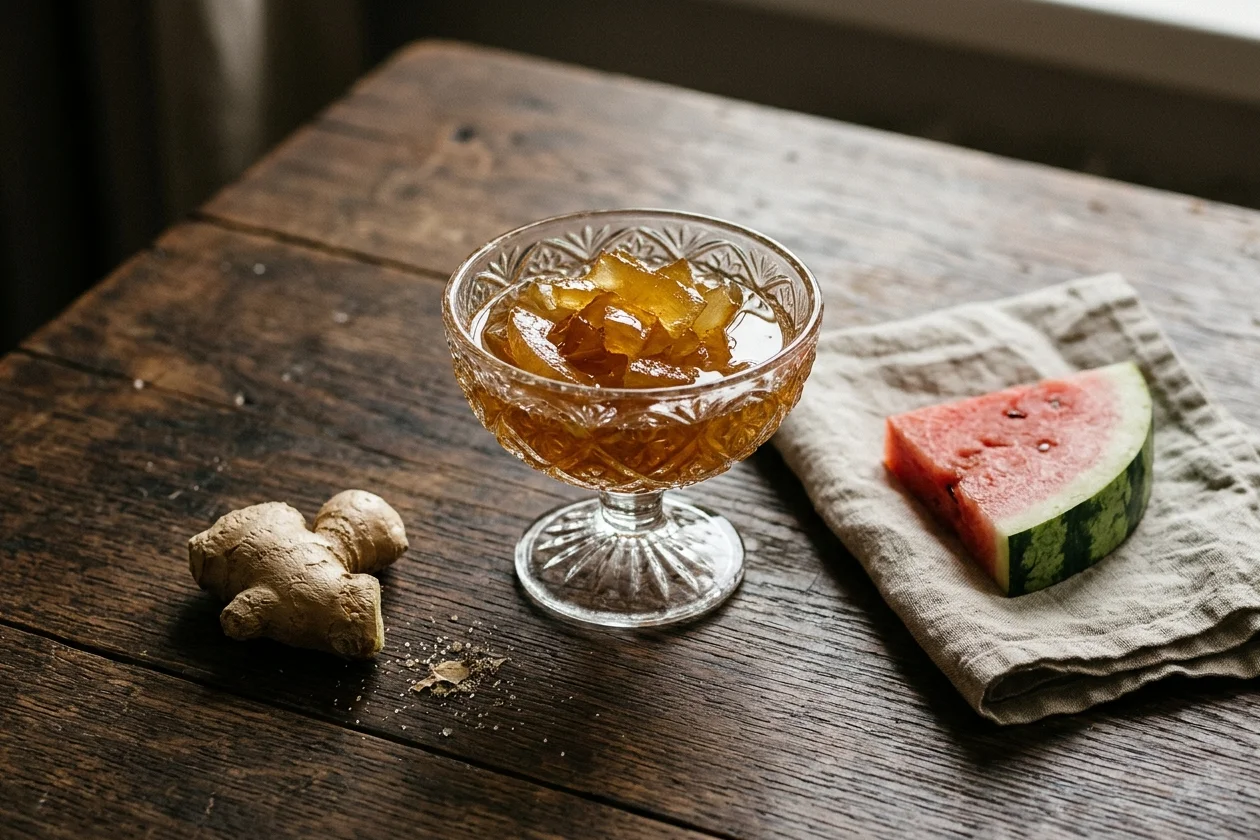
Historical sugar-syrup methods lack validated modern sterilization regimes, acidity measurements and storage conditions. Particular caution is needed with plant ingredients of unknown acidity. We can study the old sweet without reproducing its long-term storage. An appropriate illustration might show pale pieces of rind in syrup with ginger and watermelon nearby. This modern artistic reconstruction conveys composition and intention, not the exact historical appearance.
Original recipes and sources
Elena Molokhovets, A Gift to Young Housewives, 1901 edition. Links to scans are available on the original Russian recipe pages.