Cucumber and Carrot Preserves: Molokhovets's Unusual Sweets
Why cucumbers were combined with lemon and ginger, while carrots were cut into stars for decorating baked goods.
Preserves were not limited to berries
In the 1901 edition, No. 3406 is cucumber preserves, followed by two carrot entries. Another recipe for translucent carrot preserves appears as No. 4005. Their position alongside conventional sweet preserves shows that vegetables could become the basis of desserts or decorations. Their intended purposes differed, however: the cucumber version emphasizes colour and successive processing, while the carrot version emphasizes shape, translucency and prompt consumption. Not every entry should be interpreted as a method of long-term winter storage.
Which cucumbers Molokhovets chose
The author specifies very small green cucumbers resembling gherkins, without developed seeds. This matters because young and large mature fruit differ in structure and water content. The historical text describes prolonged treatment with salt and cabbage leaves, involving changes in colour. It then moves to a sweet syrup with lemon juice, zest and ginger. We do not recommend reproducing uncontrolled holding and repeated treatment according to the old account: it provides no acidity measurements, safe storage regime or microbiological criteria.
Why salt appears in a sweet recipe
In No. 3406, salted liquid is part of the preliminary treatment, not the sole seasoning of the finished preserve. Soaking follows before the transition to syrup. Salt may influence water exchange between plant tissue and the solution. However, the precise reasons for the yellowing and subsequent greening observed in the source cannot be determined without experimentation with the particular produce. We do not attribute a modern scientific theory of pigments to Molokhovets. The important point is that she sought a particular visual result before developing sweetness.
Carrot stars instead of berries
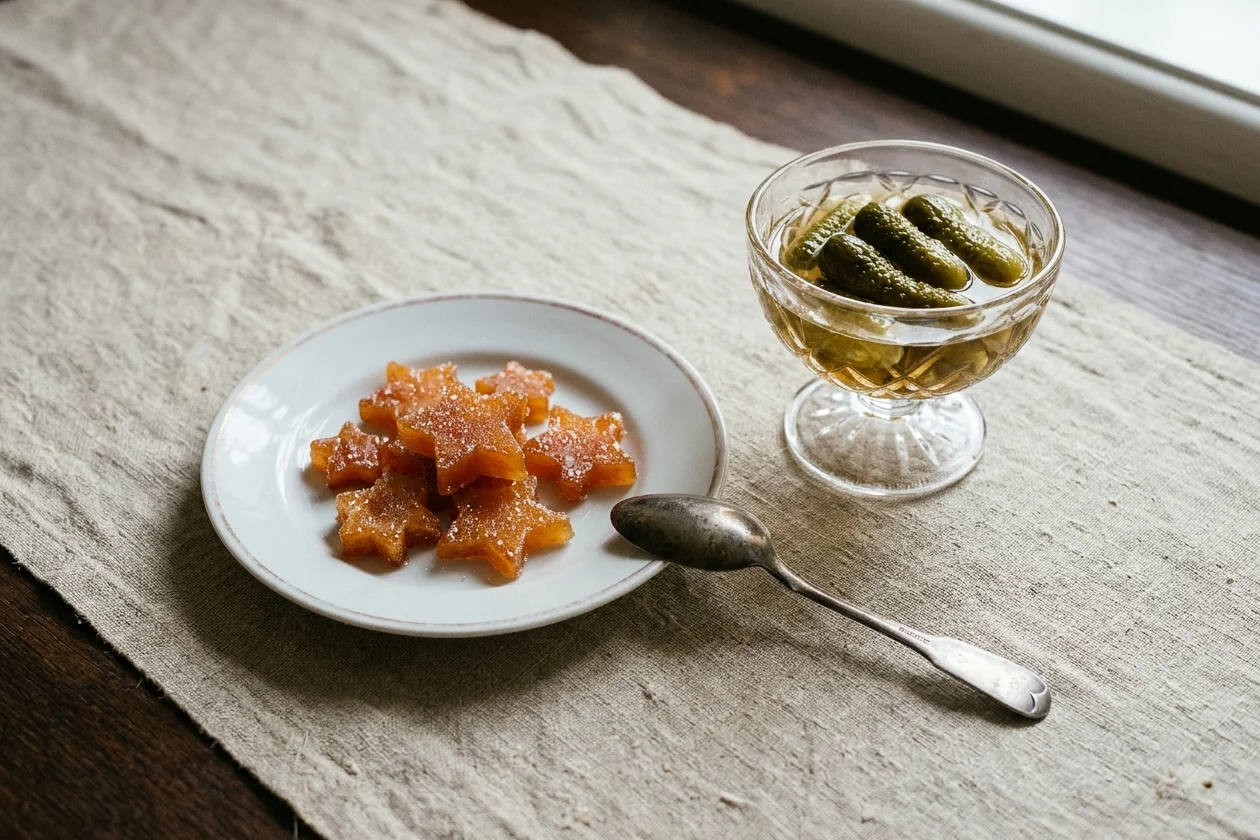
In No. 3407, yellow or red carrots are first boiled, cut into attractive stars and treated in thick syrup until translucent. This is not merely crushing a vegetable into jam: the pieces should retain their shape. Heat softens plant tissue, while the sugar solution changes its properties and appearance. Variety and thickness influence the result. The source does not promise absolute glass-like transparency, but a culinary characteristic observable to the cook.
Decorating cakes and babas
The title of No. 4005 explicitly identifies its purpose: translucent carrot preserves for decorating cakes and babas. Besides stars, the author proposes leaves and other shapes. This reveals another function of preserves: producing edible decoration. For prompt consumption, the historical proportion is half a Russian pound of sugar per pound of carrots and a glass of water. This is not a validated canning standard. Indeed, Molokhovets advises against making large stocks of this preserve because carrots are available throughout the year.
A second method with candied orange peel
No. 3408 calls for sweet yellow carrots and removal of the core. Candied orange peel, sugar and lemon juice are added to the prepared vegetable. Unlike the stars of No. 3407, a decorative shape is not essential here. Citrus additions alter aroma and acidity, bringing the carrot product closer to fruit preserves. Specifying the original carrot colour indicates that the choice of produce mattered. It does not mean that all modern yellow varieties will produce the same taste.
What modern readers should remember
These recipes are evidence of culinary variety, not validated instructions for storing vegetables in jars. Sugar and lemon juice alone do not guarantee safety, particularly for naturally low-acid vegetables. Modern practice requires tested preserving recipes. An artistic reconstruction may show little cucumbers in syrup and carrot stars in separate dishes. The difference in shapes helps explain why these vegetables appeared in the sweets section.
Original recipes and sources
Elena Molokhovets, A Gift to Young Housewives, 1901 edition. Links to scans are available on the original Russian recipe pages.