Berry Pastila: Raspberry, Lingonberry and Gooseberry
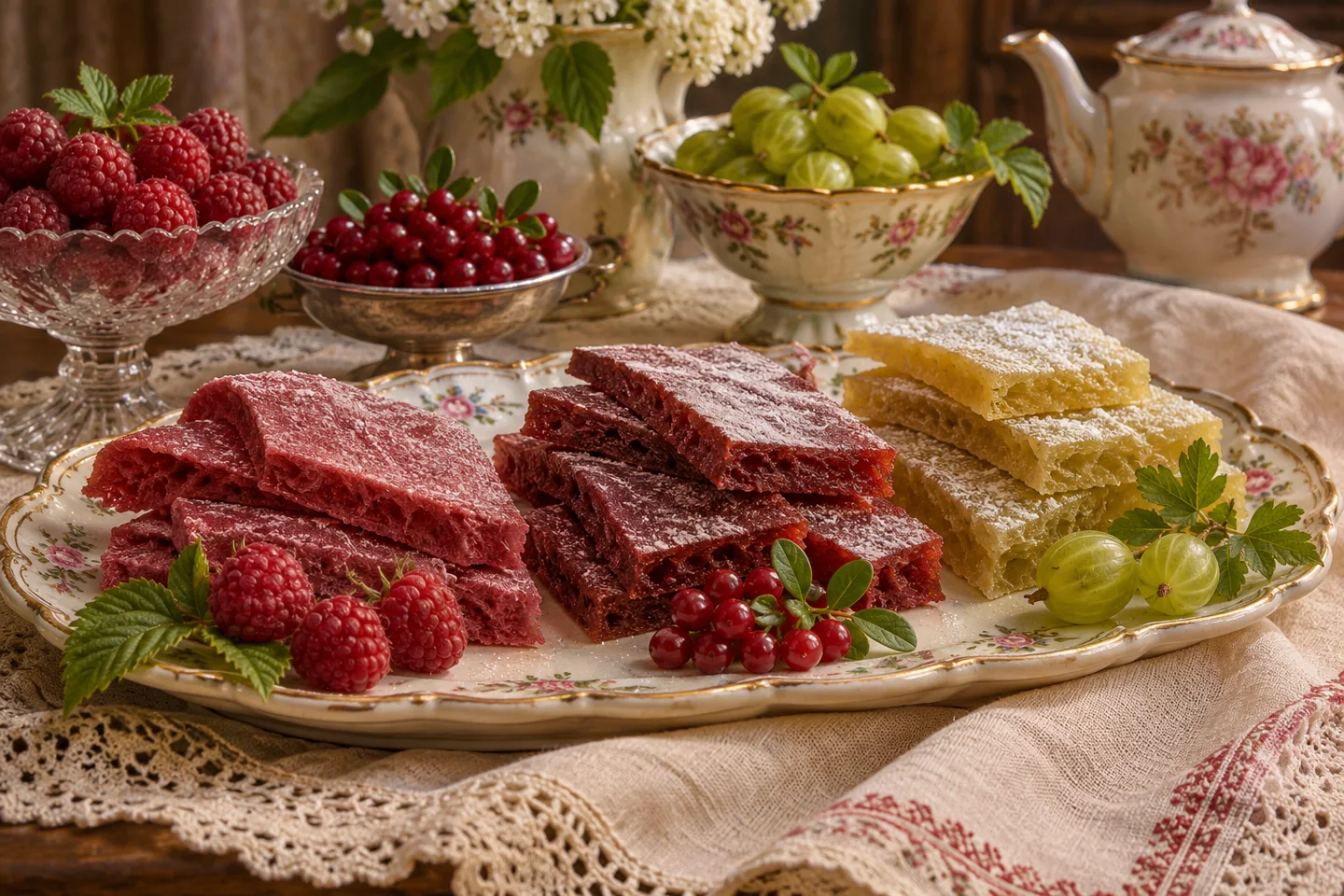
Three berries and several methods of making pastila in the 1901 edition: beating, drying in layers and boiling down.
Pastila was more than an apple sweet
In the preserves section of the 1901 edition, Molokhovets describes several pastila varieties. Among them are raspberry No. 3813, lingonberry with honey No. 3833 and gooseberry No. 3800. All involve processing a berry mixture, but preparation, sweetening and methods of obtaining firmness differ. Lingonberry pastila itself has several methods: No. 3835 describes a boiled version. Historical pastila therefore cannot be regarded as a product with only one composition or texture. The name covers multiple ways of preserving and transforming fruit.
Raspberry pastila and the use of juice
In the raspberry recipe the berries are first softened in a pot placed in the oven after bread baking. Juice is separated and the remainder sieved. Molokhovets directs the cook to raspberry juice No. 3349 and syrup No. 3329. One glass of sugar or honey is then specified for two glasses of berry mixture; it is beaten with a spatula and processed further following the lingonberry example. This illustrates how one ingredient was divided into multiple products. The separated juice is not discarded but becomes the basis of another preserve.
Lingonberry pastila with honey: separate beating
In No. 3833, prepared lingonberry purée is combined with honey in a two-to-one volume ratio. But honey and purée are beaten separately before mixing. The author seeks a smooth mixture and describes drying it in thin layers in boxes. New layers are added successively, not all at once. Water removal and gradual layering help explain the distinction between pastila and ordinary preserves. No humidity, temperature or water-activity measurements are given; historical keeping times should not be transferred to homemade products today.
Gooseberries and ripeness
No. 3800 calls for unripe or completely green gooseberries of a particular type, softened and sieved after separating the liquid. Egg white may be added for whiteness and lightness. The desired texture therefore depends not only on drying but on prior preparation of the mixture. Part of the sentence following the reference to two glasses appears incomplete in the available digital text. We do not reconstruct the missing proportion by guesswork: the scan must be checked separately. The historical article retains this limitation rather than inventing a quantity.
Boiled lingonberry pastila: another technique
No. 3835 specifies two cups of honey or sugar for four cups of lingonberries. The mixture is boiled down until a cooled sample is firm enough to cut with a knife. It is then spread on a dish and cut after setting. Here the focus is on reduction rather than successive layers of drying as in No. 3833. Comparing the entries helps explain the different structures denoted by pastila. Modern illustrations should not therefore depict all versions as identical white airy cubes.
How these methods differed from apple pastila
In No. 3726, apples are cooked, sieved and combined with sugar and egg whites, then beaten until pale and thick. The author describes special boxes and drying in an oven. Raspberry and lingonberry recipes have their own proportions and connect further operations through cross-references. These show the cookbook as a system: basic methods are described once and supplemented by variants. A short isolated entry cannot always be understood without its neighboring or referenced recipes.
What can be reconstructed today
A modern illustration can show three berry pastila varieties of different colours and densities: raspberry, lingonberry and gooseberry. Exact historical shades, dimensions and structures remain unknown. Modern preparations need validated drying methods, safe ingredients and pasteurized egg products where appropriate. Historical long-term storage in closed wooden boxes should not be considered a guarantee of safety. The focus of our study is the variety of fruit, economical use of juice and differing ways of forming the berry mixture.
Original recipes and sources
Elena Molokhovets, A Gift to Young Housewives, 1901 edition. Links to scans are available on the original Russian recipe pages.
- No. 3813 — Raspberry Pastila Russian original
- No. 3833 — Lingonberry Pastila with Honey Russian original
- No. 3800 — Gooseberry Pastila Russian original
- No. 3835 — Cooked Lingonberry Pastila Russian original
- No. 3726 — Apple Pastila from Boiled Apples Russian original
- No. 3349 — Sugar-Free Raspberry Juice Russian original
- No. 3329 — Raspberry Syrup Russian original