An Airy Pie Without Pastry: Why Molokhovets Whipped Preserves with Egg Whites
Apple, berry and prune airy pies from 1901: two methods of working with egg whites and serving straight from the oven.
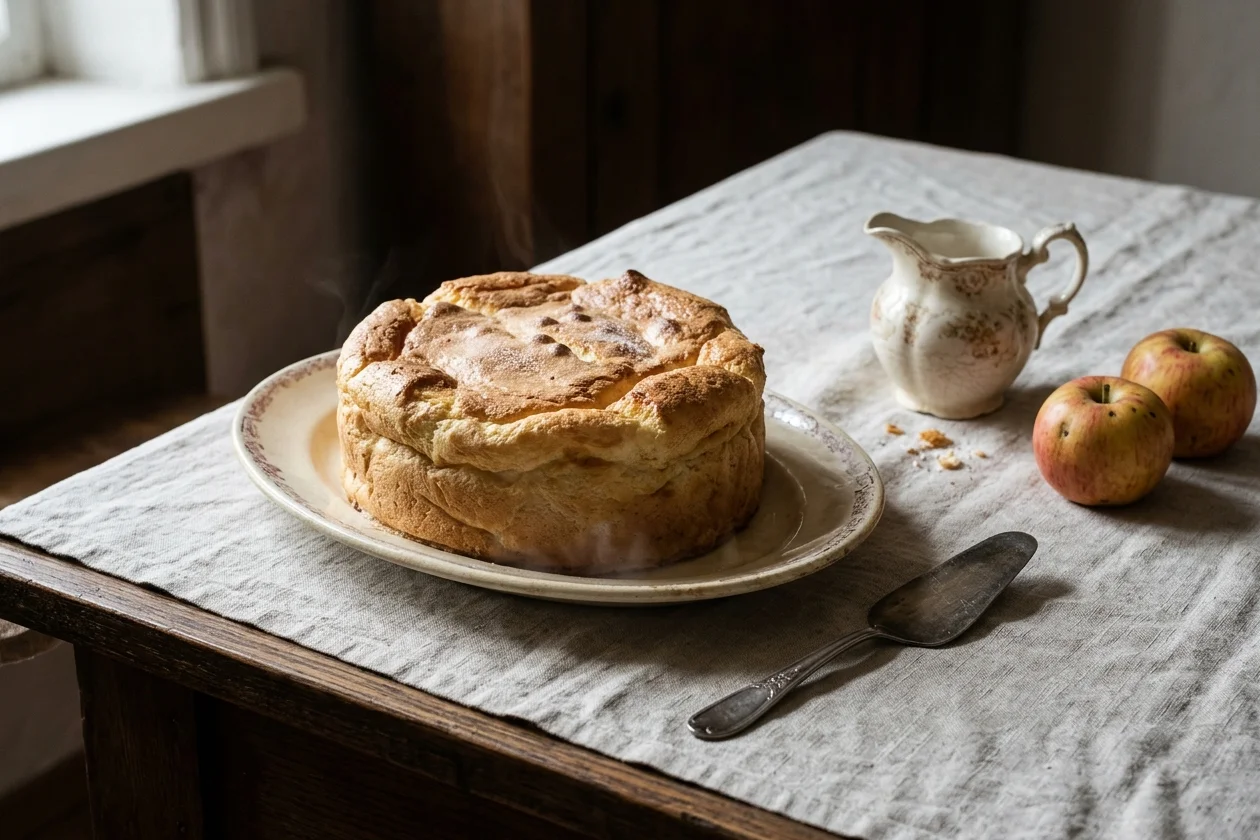
Why the airy pie had no crust
In No. 1579, Molokhovets combines thick baked-apple purée with beaten egg whites and sugar. The mixture is placed on an earthenware dish, scored and baked. The recipe specifies neither a flour-based crust, yeast nor puff pastry. Nevertheless, the author calls it a pie. To modern readers its construction is closer to a fruit soufflé, but this is an explanatory analogy rather than a replacement for the historical title. Its principal characteristics are an airy mixture and immediate serving after it has risen in the oven.
Fresh berries and thick preserves
No. 1580 proposes sieved wild strawberries or raspberries from which excess liquid has first been removed. No. 1581 permits thick raspberry or apricot preserves, gradually incorporated into beaten whites. In both cases the liquid must be sufficiently limited not to disrupt the foam. Natural pectin and sugar content vary among fruits, however, so identical volume measures cannot guarantee identical results. Preserves already contain sugar, whereas the sweetness of fresh berries must be adjusted separately. The author specifies cream with both versions.
Another method: working the whites with the preserves
In No. 1582 Molokhovets describes a more labour-intensive technique. Instead of beating the whites separately, they are combined with thick preserves containing more berries than syrup. The mixture is worked with a spoon for a long time in one direction until pale and thick enough for the spoon to stand upright. The author explicitly compares the result with the first method: in her observation, the second pie retained its volume better, although it required more work. This is valuable testimony to her practice, but not proof of identical results with any modern ingredients.
Why apple purée was reduced further
No. 1583 specifies purée made from baked Antonovka apples, subsequently reduced with sugar until the mixture falls from the spatula in pieces rather than flowing off it. Similar treatment of thick purée appears in the prune recipe No. 1584 and gooseberry No. 1586. This reveals the role of preparing fruit in advance: removing excess water and altering viscosity facilitate the formation of a substantial airy mixture. Neither temperature nor final moisture content is measured, so the household test of thickness cannot be converted into one universal numerical value.
Why the pie went into the oven during the roast course
In Nos. 1579 and 1582, baking is timed to the serving of the roast rather than an arbitrary time of day. As soon as the pie rises and browns, it should be served. This requires coordination in the kitchen: the dessert must be ready as the preceding course ends. An airy structure may lose volume during cooling, particularly if it is only weakly set. The author takes this property into account and does not recommend leaving the finished pie waiting in advance. The historical entry illuminates the organization of dinner as well as dessert composition.
What cannot be established from one description
In No. 1587 the whites are combined with hot apple mixture, whereas No. 1583 calls for cooled purée. These different methods should be preserved rather than merged into a supposedly exact instruction. Historical holding times for prepared egg mixtures and oven parameters do not establish modern food safety. Home adaptation requires safe egg products and a validated heating regime. An illustration of a browned fruit soufflé on a dish may convey the concept of the airy pie, but its height and shape are not established historical facts.
Original recipes and sources
Elena Molokhovets, A Gift to Young Housewives, 1901 edition. Links to scans are available on the original Russian recipe pages.
- No. 1579 — Airy Baked Apple Soufflé Russian original
- No. 1580 — Airy Wild Strawberry or Raspberry Soufflé Russian original
- No. 1581 — Airy Soufflé with Raspberry or Apricot Jam Russian original
- No. 1582 — Excellent Airy Jam Soufflé, Second Method Russian original
- No. 1583 — Airy Baked Apple Purée Soufflé, Second Method Russian original
- No. 1584 — Airy Prune Purée Soufflé Russian original
- No. 1586 — Airy Ripe Gooseberry Soufflé Russian original
- No. 1587 — Airy Apple Purée Soufflé, Third Method Russian original