Moscow Selyanka in a Pan: Why Molokhovets's Solyanka Was Not Always Soup
Comparing thick Moscow selyanka, cabbage dishes with meat or fish, and liquid selyankas in the soup sections of the book.
Selyanka before the broth, rather than in its place
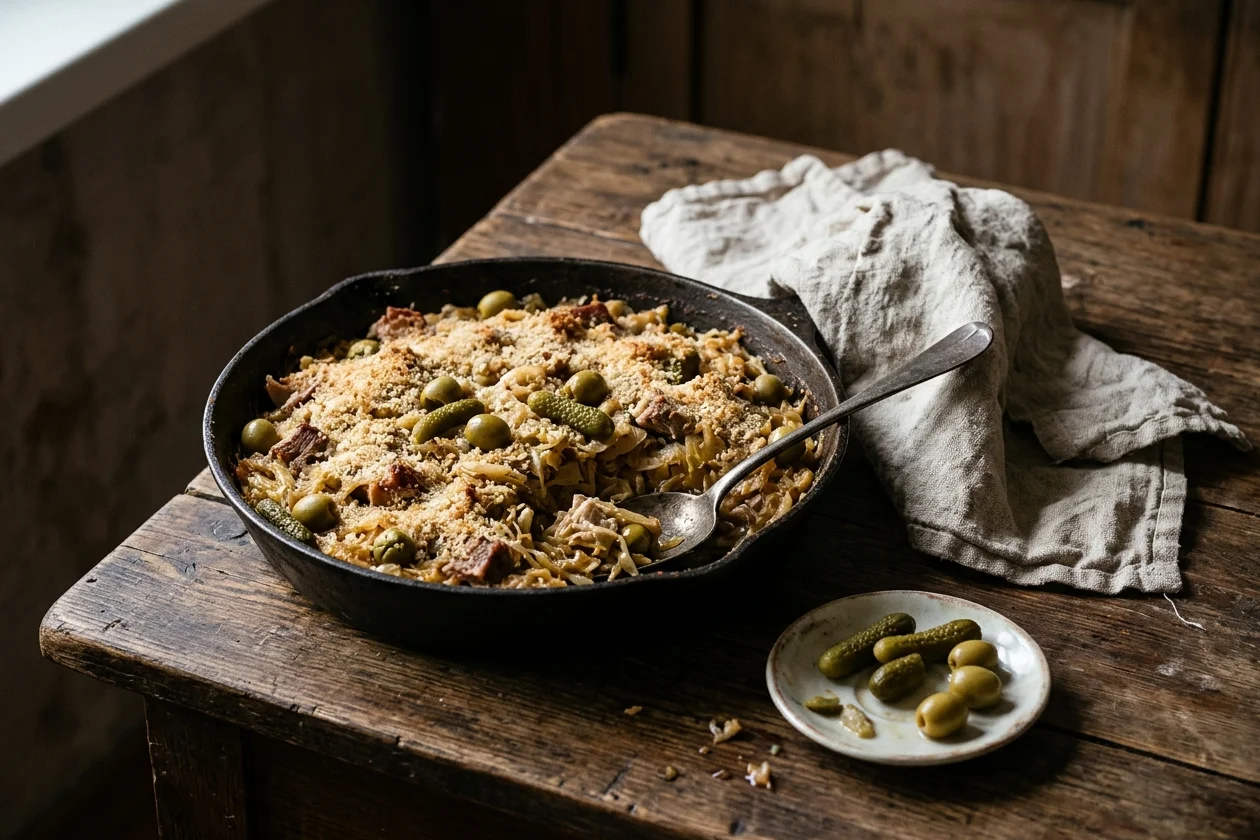
In No. 551, Molokhovets explicitly says that Moscow selyanka should be thick. If served at dinner, it precedes the broth, but is more often intended for breakfast. This detail alone prevents the recipe from being understood as an ordinary soup. Its base is braised sauerkraut, layered with different kinds of cooked roast meat. Additional ingredients are arranged on top and the dish browned in the oven. We retain the spelling selyanka used in the book's headings without attempting to establish one definitive origin for the word solyanka.
How Moscow selyanka was assembled
The author first prepares cabbage with fried onion and butter, then adjusts it with a little flour. The prepared cabbage is transferred to a frying pan in layers alternating with pieces of beef, veal, ham, chicken or game. The uppermost layer is cabbage again. The meat is not necessarily of one particular kind but forms part of a mixed composition. Cooked roast and raw meat must be distinguished here: Molokhovets specifically refers to already prepared meat products. The dish is served in the same pan in which it was browned.
Cucumbers, mushrooms and roast gravy
The surface is decorated with pickled cucumbers, gherkins, olives and pickled mushrooms. Truffles and sausages are among the additional options. Roast gravy is then poured over the selyanka. This is both a flavouring and decorative operation: small additions lie on the surface while the liquid brings the ingredients together. Not every listed ingredient is mandatory in every reconstruction, and the source does not prove that expensive ingredients were available to every household. More important is the combination of acidic cabbage and pickles with rich meat gravy.
Fish and meat versions with cabbage
No. 549 specifies selyanka with fish, adding peeled sour apples to sauerkraut. The cabbage is layered with cooked fish, covered with sauce and browned. No. 2453 describes a related composition with additional decorative options. Meat selyanka No. 550 is constructed differently: cabbage is stewed with dried mushroom stock, combined with cooked meat products, then transferred to a pan and baked. These differences show that not every thick selyanka required layered assembly.
When selyanka really was soup
No. 59 belongs to the soup section: white beef stock is combined with assorted meat, mushrooms, cucumbers, olives, brine and sour cream or cream. Assorted fish selyanka No. 140 is based on fish stock with fresh and salted fish, crayfish tails, pickled additions and lemon juice. No. 141 also includes cabbage and cucumber brine. Unlike the Moscow dish in a frying pan, these entries explicitly describe a liquid base and serving as soup. Shared individual ingredients do not eliminate differences in preparation.
Two serving forms under related names
Thick selyanka demonstrates the importance of context in an old recipe. A title alone cannot tell us whether the finished composition belongs in a soup tureen or retains its shape in a frying pan. A reconstruction of the Moscow version should show baked cabbage rather than a bowl of soup. When using leftover roast and cooked fish, safe cooling, refrigerated storage and thorough reheating are necessary. The historical description does not establish modern storage times.
Original recipes and sources
Elena Molokhovets, A Gift to Young Housewives, 1901 edition. Links to scans are available on the original Russian recipe pages.
- No. 551 — Moscow-Style Selyanka in a Frying Pan Russian original
- No. 549 — Sauerkraut Selyanka with Fish, Served in a Sauté Pan Russian original
- No. 550 — Sauerkraut Selyanka with Meat Russian original
- No. 2453 — Sauerkraut Solyanka with Fish Russian original
- No. 59 — Meat Solyanka (Selyanka) Russian original
- No. 140 — Assorted Fish Selyanka (Solyanka) Russian original
- No. 141 — Fish Selyanka with Cabbage Russian original