Apple and Berry Kholodets: Why Molokhovets's Kholodets Was Not Always Meat Jelly
Apple, cherry, berry and almond kholodets in the 1901 book: chilled sweet soups with sponge biscuits and dumplings.
Why the name is misleading today
Today kholodets is most often associated with a meat dish that sets after cooling. But in Section XXV of Molokhovets's book, apple, cherry, berry and almond preparations bear the same name. No. 2351 proposes a sieved apple base with wine and optional dumplings. No. 2353 specifies berry purée with cream or sour cream. These texts describe chilled dishes served in soup vessels, not necessarily solid jellies. The name must therefore be read alongside the ingredients.
Apple kholodets and its additions
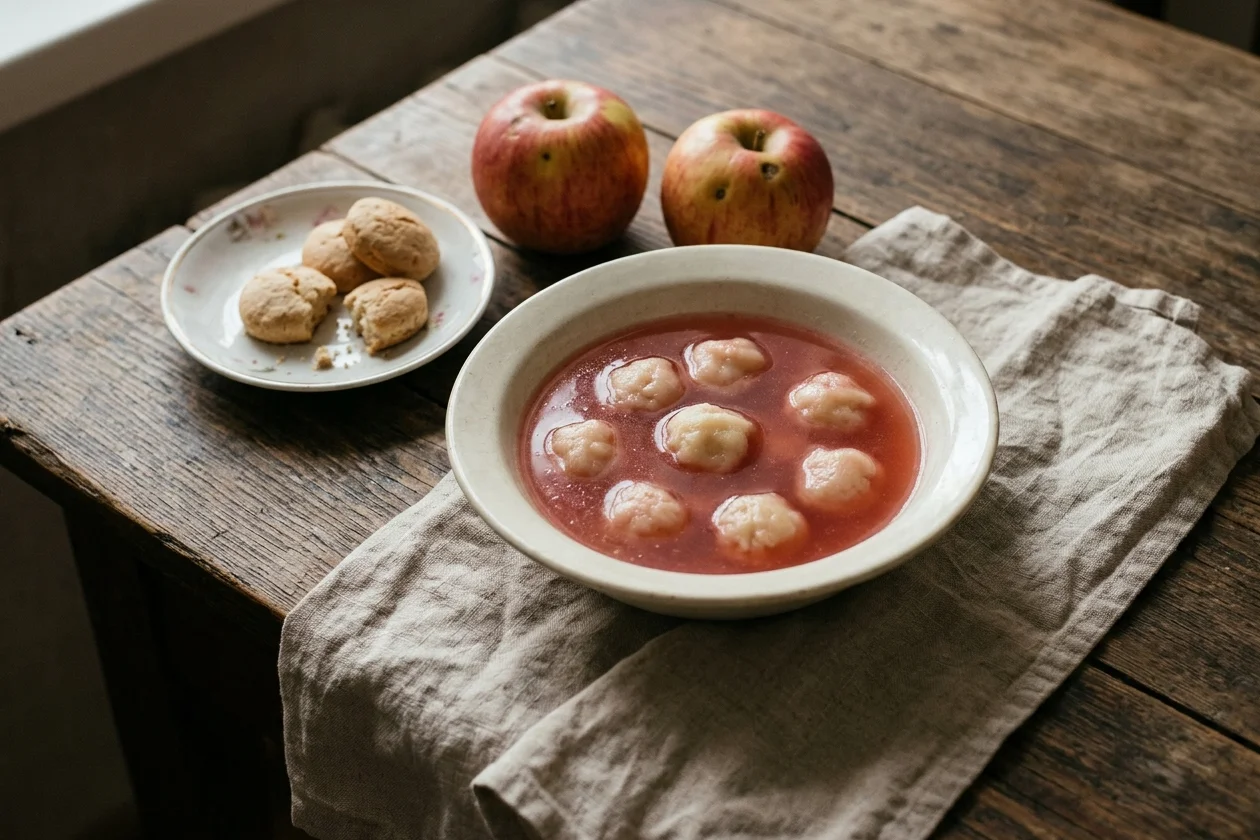
In No. 2351, apples are treated with water, cinnamon, lemon zest, a little wine and grated white bread. After sieving, the liquid in which the fruit was cooked and other components are added to the base. The author mentions red wine, lemon juice, preserves and sugar. The composition combines fruit purée and liquid, with bread potentially affecting thickness. No gelatin is specified to set the entire dish. The category of chilled fruit soup better explains the recipe.
Unusual apple dumplings
An additional apple kholodets variant includes dumplings. Their base contains grated apples, eggs, grated white bread, sugar and spices. The author cooks them separately in part of the soup and cools them before combining them with the remainder. This demonstrates that kholodets could contain distinct solid elements. They do more than decorate a dish: they change its structure and how it is eaten. A modern illustration may show small dumplings in a liquid fruit base without treating them as obligatory in all versions.
Cherry kholodets and an important limitation
No. 2352 describes a sweet chilled dish made from cherries, sugar, wine and lemon juice or sour cream, served with sponge biscuits. The historical text processes cherries together with their stones. This should not be repeated: stone-fruit kernels may contain cyanogenic compounds, and the old method establishes no safe processing regime. A modern interpretation may use only edible, pitted fruit flesh. The wine also means the dish cannot automatically be regarded as alcohol-free.
Berry kholodets without mandatory wine
No. 2353 is entitled kholodets of raspberries, wild strawberries, strawberries or currants with wine. In the available text, however, the principal method uses sieved berries, sugar, cream or sour cream and whole berries, without explicitly adding wine. We do not resolve the discrepancy by guesswork. It may reflect an omission in the digital text or a feature of the original heading that should be checked against the scan. Pastries, sponge biscuits or 'Spanish wind' are suggested as accompaniments, confirming the recipe's place on the sweet table.
Almond kholodets: a cold version of soup
No. 2354 refers to almond soup in the manner of chocolate soup, No. 2340, and instructs that it be served cold. This pair particularly clearly illustrates how serving temperature could affect a dish's name. Almond liquid, toasted flour, spices and sugar form the base, while chocolate in No. 2340 coats separate rusks. We should not assume the kholodets itself necessarily contains cocoa in its main mixture. A safe modern adaptation must not use the bitter almonds found in old referenced recipes.
Reading historical names without changing their meaning
Molokhovets's fruit kholodets does not negate the existence of meat studen or aspic. Rather, it shows that different compositions in one book could share a name associated with cooling and serving. A historical essay is useful alongside the original numbered entries because it explains the word without rewriting the source. An illustration need only show one fruit version in a deep porcelain bowl. Colour and presentation remain modern conjecture; safe use of the chilled dish requires appropriate refrigeration.
Original recipes and sources
Elena Molokhovets, A Gift to Young Housewives, 1901 edition. Links to scans are available on the original Russian recipe pages.