Muscovite Jelly: Frozen Edges and a Soft Centre
Nos. 1967 and 2723 describe Muscovite jelly: citrus syrup, a special mould, ice and salt, and a remarkable two-coloured texture.
Not two layers, but two textures
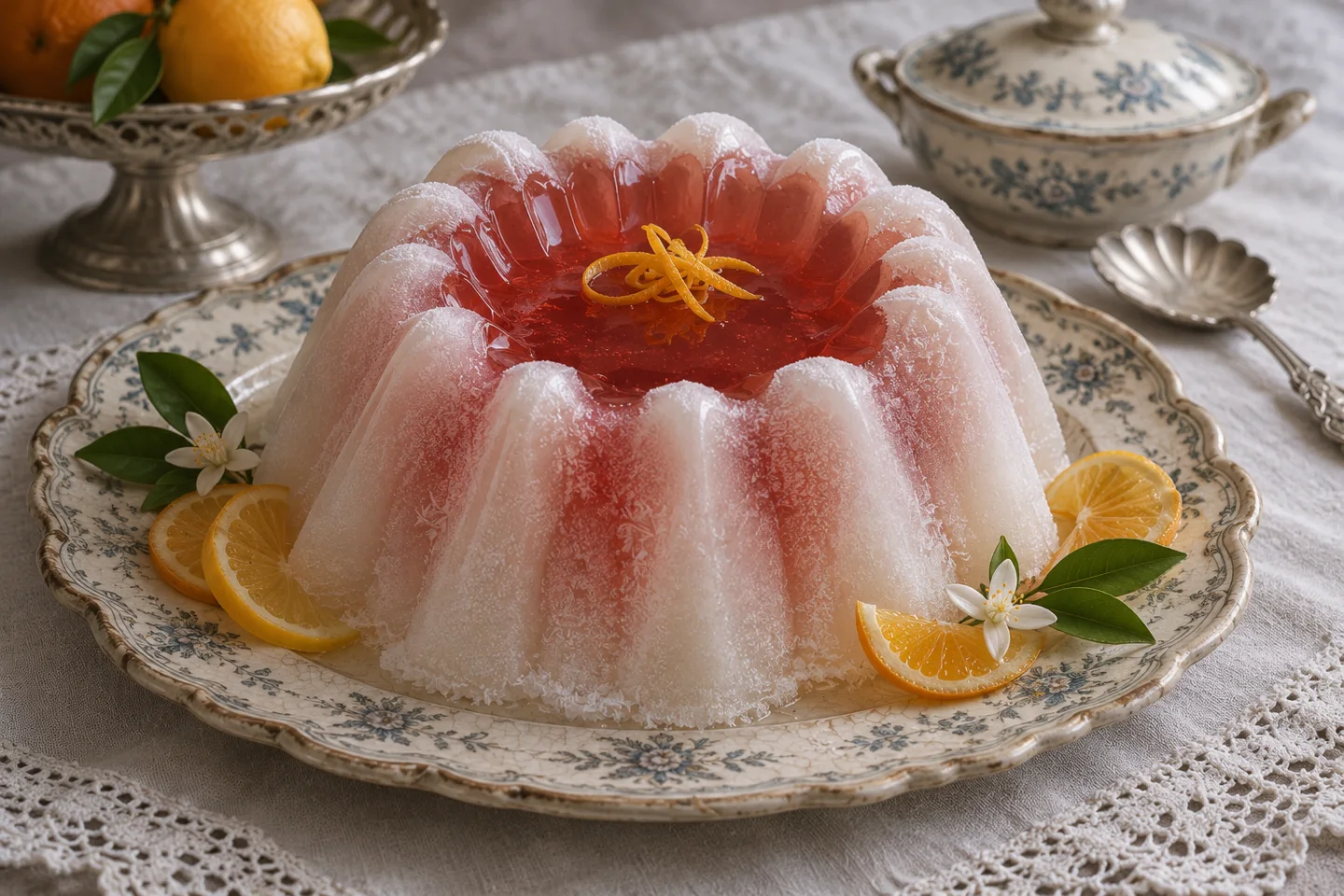
Molokhovets's Muscovite jelly differs from ordinary jelly not only in appearance but in its processing. The author requires the edges to freeze while the centre remains soft, with the consistency of a soft-boiled egg. The dessert should look snow-white outside and red within. This is not an instruction to pour successive red and white layers. The text describes a single citrus mixture chilled in a special mould and then frozen at the edges. The difference in physical state is the central puzzle of the dessert.
How the base was composed
Molokhovets begins with syrup made from three and a half glasses of water and three-quarters of a Russian pound of sugar. It is boiled with lemon and orange zest, then mixed with the juice of a lemon and several oranges. The author emphasizes clarity and advises against squeezing the fruit too hard. A solution of six sheets of white and one sheet of red gelatin is added. The liquid is strained through a wet cloth into a mould. Red gelatin is part of the mixture itself, whereas the author associates the white exterior with subsequent freezing. The source does not establish the modern gelling strength of the sheets.
Why ice and salt were required
The mould was first placed on ice so the mixture could begin to thicken. It was then closed and set in ice with salt, turning it in different directions until the edges froze. Salt lowers the freezing point of water in an ice mixture, allowing the cooling medium to become colder than ordinary melting ice. Contact with the mould walls accelerates cooling of the outer part, while the centre cools more slowly. Turning could have helped distribute cold over the surface, but the author gives neither a precise speed nor duration. This is an example of historical temperature management without modern freezing equipment.
How the white exterior might have arisen
When liquids freeze, light may scatter from ice crystals, irregularities and microbubbles, making an initially clear coloured mixture appear more opaque and pale. This is a plausible explanation of the effect described, not the result of an experimental reconstruction of this particular jelly. Freezing speed, sugar, gelatin properties and juice composition all affect the result. The source establishes only the intended visual outcome: snow-white edges and a red centre. An illustration must not present the hypothetical appearance as an authentic archival specimen.
Why the recipe occurs twice
No. 1967 belongs to the section on ice creams, creams and jellies, while No. 2723 appears among fasting-day desserts. The available digital texts are virtually identical: both list citrus fruit, sugar, white and red gelatin, ice with salt and a mould. Gelatin's appearance in a fasting-day section does not automatically make the recipe suitable for a modern vegan diet. Its origin and historical interpretation of permitted fasting ingredients require further study. Neighboring No. 1968 is called jelly of several colours; the separate entry suggests studying Muscovite jelly through its particular technique, not simply its colouring.
Unmoulding and serving the dessert
The author finally instructs the cook to dip the mould briefly in hot water and turn its contents onto a dish. The purpose is to release the exterior from the walls. The mould's form, dimensions and material are not described in detail, so the exact appearance of every finished jelly is uncertain. A modern reconstruction may show a pale frozen surface and soft reddish centre, with an appropriate caption. The origin of the name 'Muscovite' also remains open: without comparing earlier cookbooks and foreign-language recipes, we cannot confidently establish where it originated.
Original recipes and sources
Elena Molokhovets, A Gift to Young Housewives, 1901 edition. Links to scans are available on the original Russian recipe pages.
- No. 1966 — Lemon Jelly with or without Wine Russian original
- No. 1967 — Moscovite Jelly, Frozen at the Edges Russian original
- No. 1968 — Layered Jellies in Several Colours Russian original
- No. 2722 — Mixed Fruit Jelly Served in a Watermelon Russian original
- No. 2723 — Moscovite Jelly (Gelée Moscovite) Russian original
- No. 2724 — Lemon Mousse Russian original