Molokhovets's Coffee Ice Cream: Why Coffee Was Added Straight from the Roaster
Two neighboring recipes, Nos. 1895 and 1896: flavouring cream with freshly roasted coffee or using a strong coffee infusion.
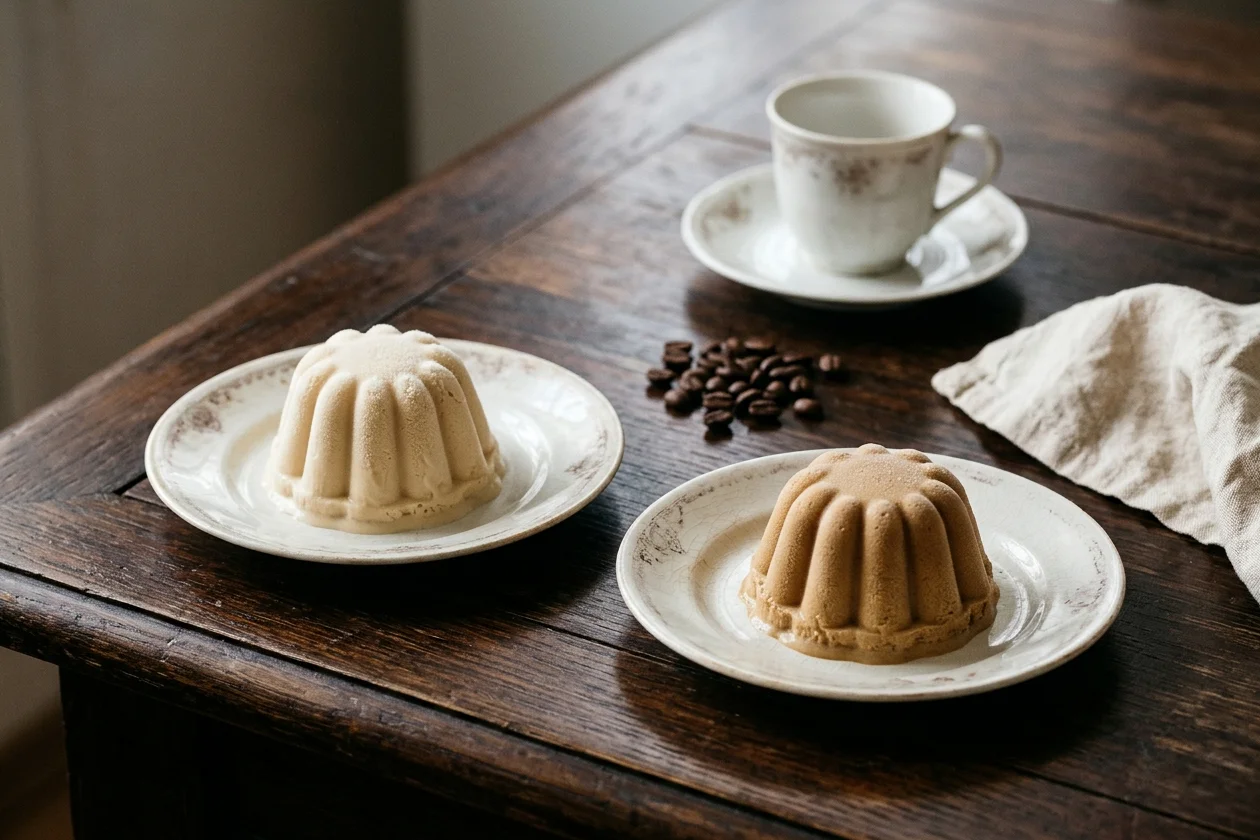
Two recipes with different flavouring methods
Nos. 1895 and 1896 describe cream-based coffee ice cream. Their difference appears before freezing. In the first, coffee is added immediately after roasting to a hot cream base, infused and strained. In the second, strong coffee is prepared separately and combined with cream or milk. These are not merely different names for the same dessert: extraction methods differ. In one, the dairy liquid carries the flavour; in the other, a previously prepared water-based infusion does.
What 'straight from the roaster' means
No. 1895 emphasizes freshness of roasting. Yolks are first worked with sugar, mixed with cream and heated until thickened. Freshly roasted coffee is added, the mixture removed from heat and left covered until cool. The main text does not mention preliminary grinding, whereas No. 1896 explicitly requires ground coffee. Whole beans may have been used in the first case, but the source does not describe particle size after processing. Fresh roasting is an explicit requirement; the exact grinding technique remains unknown.
Strong coffee as a separate ingredient
No. 1896 specifies enough water for three-quarters of a glass of ground coffee to produce one glass of strong coffee. The infusion is combined with two glasses of milk or cream, four yolks and sugar. No. 1895 gives three glasses of dairy base and half a glass of roasted coffee by volume. The total volume of the principal liquid is approximately similar, but its composition differs. Equal volumes of roasted and ground coffee cannot be regarded as equivalent weights: density and packing differ.
Why colour and strength might differ
Coffee components transfer differently into water and dairy liquid. Particle size, degree of roasting and contact time also affect extraction. The two recipes could therefore produce different shades, aromas and bitterness. This explanation rests on general extraction properties rather than an actual reconstruction: the original coffee varieties are unknown and caffeine has not been measured. We cannot assert that either version was necessarily lighter or stronger than the other.
What 'and so on' refers to
Both short coffee entries end with a cross-reference phrase instead of repeating the whole freezing process. The basic No. 1894 describes the ice cream machine, the external ice-and-salt mixture, turning and removal of the frozen product from the mould. Salt is for the cooling medium; the author warns against letting it enter the dessert. Neighboring No. 1897 similarly flavours a dairy base with walnuts and orange blossom water. These recipes show how the book saved space by reusing a common technique.
A modern view of the two coffee versions
Leaving the mixture until cool, as the historical text says, does not establish a safe temperature regime for eggs and dairy. Practical adaptation requires validated treatment of the base, rapid cooling and refrigerated storage. Two moulded servings may illustrate different methods but do not prove a difference in colour or taste of the historical products. The central interest is the choice of flavouring method: coffee directly in the cream liquid or a previously extracted coffee infusion.
Original recipes and sources
Elena Molokhovets, A Gift to Young Housewives, 1901 edition. Links to scans are available on the original Russian recipe pages.