Two Siberian Pelmeni Recipes in 1901: What Made Them Different?
How two neighboring Siberian pelmeni recipes in the 1901 cookbook differ, and what they can and cannot tell us about dumpling history.
Two recipes stand next to each other in the 1901 edition of A Gift to Young Housewives: “Siberian Pelmeni” and “Real Siberian Pelmeni.” Their names are nearly identical, but the fillings, seasonings and serving methods differ. The point of comparing them is not to proclaim one the only authentic version; it is to see what the book actually says.
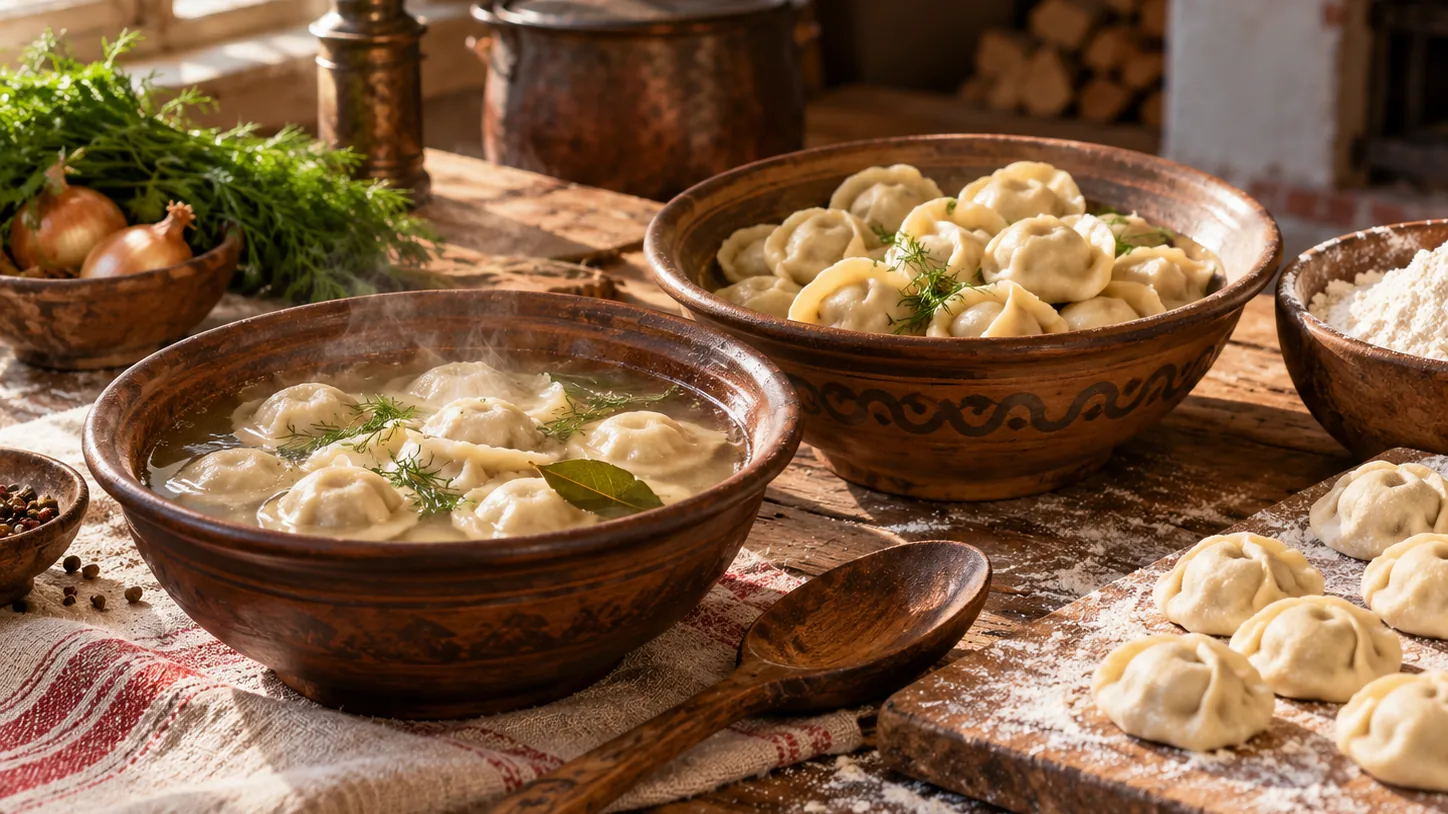
Two separate recipes, not two labels for one dish
Recipe No. 1696 includes pork, kidney fat, game or beef, onion, spices and finely crushed ice in the filling. No. 1697 relies on beef, onion and pepper, with separate directions for shaping small dumplings, serving them with broth, and freezing supplies.
Why did Molokhovets include two Siberian variants?
Both occur in Section XVI, among kolduny, mushroom dumplings and vareniki. The arrangement resembles a collection of versions of one type of dish: common dough, followed by different fillings and ways of serving. Molokhovets does not give an origin story for either recipe, so it would be wrong to invent who passed each version to her.
The word “real” in the title of No. 1697 is part of the 1901 source. It is not historical proof that No. 1696 was “fake” or that other preparations were mistaken. A single title cannot establish the customs of an entire region.
No. 1696: pork, game, spices and crushed ice
For “Siberian Pelmeni,” Molokhovets directs the reader to finely chop an onion and add half a Russian pound of raw pork, half a pound of kidney fat, and half a pound of boneless game or raw beef. The seasonings include two kinds of pepper and cloves. Finely crushed ice is also mixed into the meat filling—a detail easily overlooked among the ordinary ingredients.
The ice appears specifically in the description of preparing the stuffing. The recipe does not explain its technical purpose, so it would be inappropriate to attribute a modern food-science explanation to the author without further evidence. We can say only that she deliberately lists ice among the filling components.
After boiling, the dumplings may be served with a red meat sauce enriched with butter and either lemon juice or vinegar. Another option is to serve them in the broth in which they cooked. Even one recipe therefore permits more than one presentation.
A discrepancy inside the recipe
There is a telling inconsistency in No. 1696. The main instructions call for raw pork and kidney fat; the concluding “Issue” or ingredient list instead specifies “½ pound of ham” and does not repeat the quantity of fat separately. We retain this difference because it exists in the available historical transcription. Quietly replacing one ingredient with another would make an editorial correction look like an exact quotation.
Possible explanations range from a typographical error to an abbreviated list, but the page itself proves none of them. Both the running instructions and the closing list deserve attention, especially before preparing a contemporary adaptation. Inconsistencies in old cookbooks are themselves useful evidence about the nature of the source.
No. 1697: beef, onion and little “ears”
In “Real Siberian Pelmeni,” No. 1697, the filling is made differently. Molokhovets proposes scraping fatty beef with a knife and combining it with finely chopped, squeezed raw onion, salt and ordinary pepper. If the beef is too lean, kidney fat may replace a portion of it. This version does not mention pork, game, cloves or crushed ice.
The author advises making the dumplings quite small—roughly the size of kolduny, or shaped like small ears. That advice belongs to this particular version, not to a supposed universal shape of pelmeni.
There is also a difference of quantity. If they are served in strong broth, Molokhovets considers half of the specified dough and filling sufficient. The dumplings may thus be a separate dish or part of a first course.
The common dough and methods of shaping
Both preparations refer back to No. 1691, “Dough for Kolduny, Pelmeni, Vareniki, Noodles, etc.” Its ingredients include flour, egg yolks, water and salt. The dough is rolled thin, small portions of filling are placed on it, and the edges are firmly sealed to prevent the contents escaping during cooking.
In No. 1691 Molokhovets distinguishes sizes: smaller cutters for kolduny and larger ones for pelmeni. The later suggestion, in No. 1697, that Siberian pelmeni should be the size of kolduny is therefore meaningful—she departs from the larger form described just a few pages earlier.
That section also includes mushroom pelmeni, No. 1694, and pelmeni with mushrooms and ham, No. 1695. These entries show that the cookbook did not restrict the word pelmeni to one meat stuffing. They do not prove that every such filling was specifically Siberian.
In broth, or separately with vinegar?
No. 1697 directs the cook to boil pelmeni in salted water or stock, in a separate pot. They may then be moved into a strong, clear broth, with strained liquid from their cooking pot added to it. Alternatively, they can be lifted out with a skimmer and served on a dish with vinegar alongside.
Compare that with No. 1696, where the red meat sauce may contain butter, lemon juice or vinegar, while serving in cooking broth is another possibility. The two entries offer several solutions for an otherwise recognizable dough-and-meat dish.
Historical boiling directions are not a substitute for contemporary standards of safe cooking temperatures for raw minced meat.
Freezing dumplings for later
The most striking household detail comes at the end of No. 1697. Molokhovets says Siberians make pelmeni ahead, sprinkle them lightly with flour so they do not stick together, freeze them, and boil them in salted water when needed.
This fits the broader practices discussed in our study of food preservation before refrigeration: in cold regions, seasonal outdoor temperatures could help preserve prepared food. But the recipe gives no measured temperature, reliable storage duration or sanitary conditions. It is evidence of a practice, not a modern frozen-meat-storage instruction.
Two details must not be confused: crushed ice is mixed into the filling in No. 1696, whereas the completed dumplings are frozen in No. 1697. Their places in the text, and their possible purposes, are different.
Does “Siberian” mean the dish originated only in Siberia?
A recipe title cannot settle the origin of a dish. Historians and ethnographers have examined older food traditions in the Urals, including those of the Udmurts and Komi-Permyaks, as well as related flour-based dishes among neighboring peoples. In a 2018 study in Ethnographic Review, Nadezhda Shutova considers forms, fillings and ritual meanings and argues for development within the Komi-Udmurt cultural environment.
The Perm historian Pavel Korchagin offered another reconstruction of the time and circumstances of the dish in “Pelmeni: Where the Ears Come From” (2016). Differences between scholarly accounts are a reason to resist a neat legend about a single inventor or birthplace.
The firm conclusion from Molokhovets is narrower: by 1901, two distinct recipes could appear side by side under the designation “Siberian.” The book records ingredients, shaping, serving and freezing, but does not show what every Siberian household actually cooked.
What the two pages contribute to culinary history
Even a familiar dish proves more complicated on close reading. We find two meat-and-spice combinations, alternative ways of serving, a special recommendation for small shapes and a description of winter supplies. The inconsistency between the prose and ingredient list of the first recipe is a further reminder to read old sources carefully.
We do not need to declare a winner between the two pelmeni recipes. The more useful approach is to preserve their differences and let readers open the original entries for themselves.
Compare the 1901 recipes
Other entries: mushroom pelmeni No. 1694, mushroom-and-ham pelmeni No. 1695, and Ukrainian pelmeni No. 1698. The scholarly works by Shutova (2018) and Korchagin (2016) supplement rather than replace the original book.