Pot-case: A Forgotten Curd Cheese with Saffron and Sherry
What the name Pot-case means in recipe No. 3657: curd cheese, sour cream, saffron and sherry, and why the historical maturation method should not be reproduced at home.
What the name means in the book
In the dairy section, next to mushroom cheese, No. 3657 is headed 'Homemade Pod-kez (Pot-case)'. This is not a meat appetizer: fresh curd cheese is the principal ingredient. Molokhovets describes its processing followed by additions of sour cream, sherry, salt and saffron. The unusual Latin-letter rendering deserves attention, but the entry gives neither an etymology nor a country of origin. We retain the form printed in the available source and do not present speculative translations as established facts.
Curd cheese as the starting material
The entry begins with freshly made curd cheese, from which the whey must drain. Pot-case thus belongs to products made from an existing dairy curd. This differs from No. 3659, where cream curdles during preparation of the dish itself, and No. 3660, where fresh curd cheese is rubbed with butter and immediately shaped. In Pot-case, changes during maturation matter as well as mixing ingredients. The historical account permits comparison of these methods without suggesting that uncontrolled processing be reproduced at home.
Why Limburger cheese is mentioned
Molokhovets compares the smell of the matured curd cheese to Limburger. This indicates the character she expected, but does not mean that Pot-case is Limburger or is made using the same microorganisms. The entry specifies no validated cultures, measurable temperature, acidity or sanitary control. It also mentions the appearance of mould. This calls for particular caution today: unknown mould on a soft dairy product does not become safe when scraped from its surface. We do not present the sequence and maturation times as cooking instructions.
Sour cream, sherry and saffron
At the end of the historical account the curd cheese is combined with fresh sour cream, sherry, salt and a little powdered saffron. The author stipulates that the cheese should not be excessively yellow. This is evidence of deliberate control of its appearance: saffron is not merely a spice listed in the ingredients but an addition with an intended colouring effect. Sour cream changes density and richness. Sherry supplies a distinct aroma, but does not make the product safe for extended storage. Its exact historical taste cannot be reconstructed without testing.
Wine and the neighboring Stilton entry
The next recipe, No. 3658, concerns Stilton cheese. Molokhovets also describes using wine there, but its initial technique and the stage of adding wine differ: that separate cheese recipe begins with milk and cream. Their proximity gives reason to study wine as a culinary addition to dairy products. The book alone cannot establish that both methods exactly matched known foreign cheesemaking techniques. Comparable historical primary sources would be required.
How the historical book described readiness
In domestic recipes of the period, readiness was often judged by smell, appearance and consistency. Molokhovets also specifies a storage vessel. Sensory assessment, however, does not detect every hazardous microorganism or toxin. This matters especially for soft dairy mixtures. Modern cheesemaking requires control of ingredients, microorganisms and the environment. Pot-case can be studied as a historical example and illustrated using a safe prepared food product. We do not recommend literally repeating the maturation method of No. 3657.
What the dish might have looked like
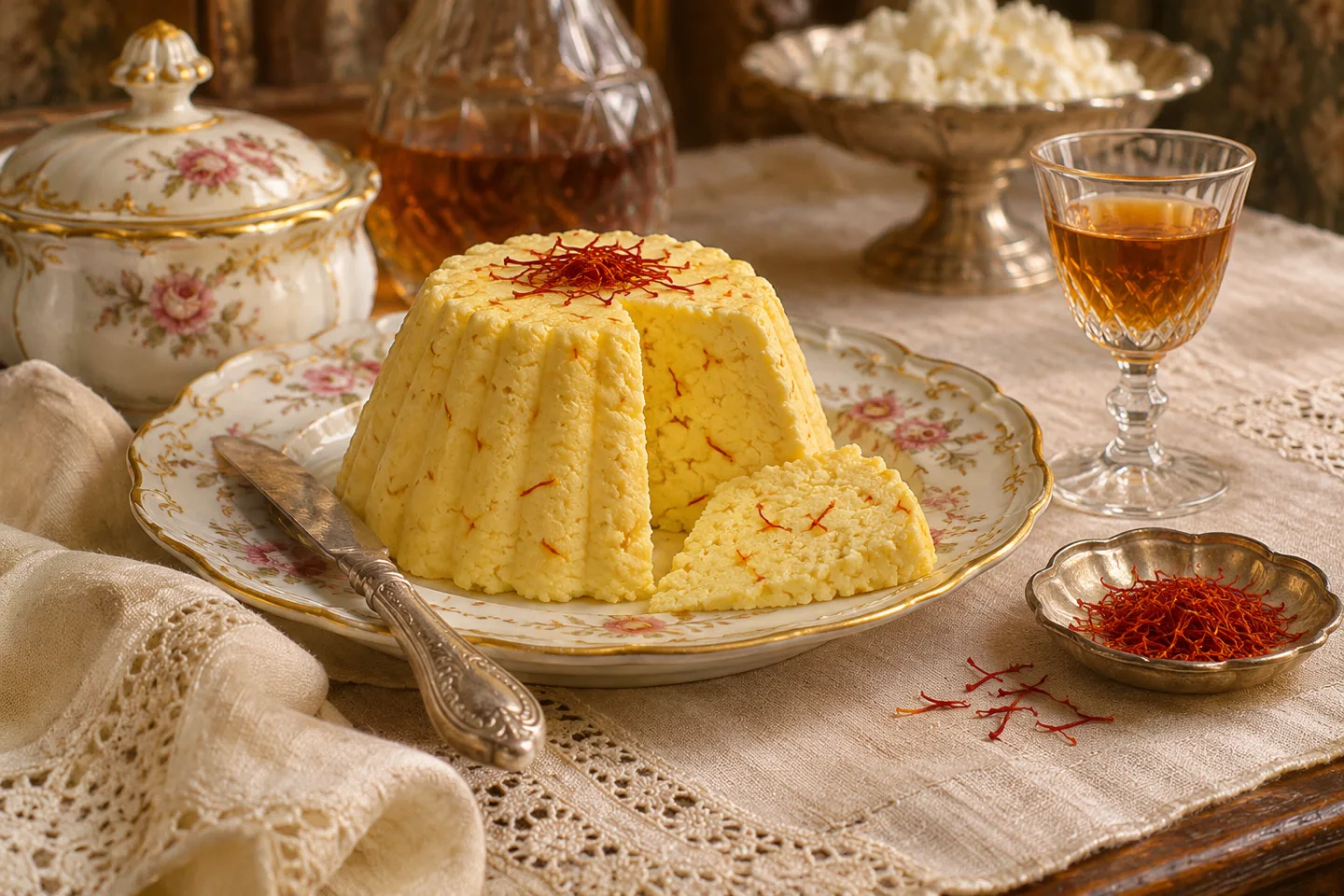
The source describes a mixed curd cheese with a moderate yellow tint. A possible artistic reconstruction is therefore a soft, creamy cheese in a small earthenware bowl, with saffron and a small glass of sherry nearby. This is an illustration, not an archival image or proof of the exact serving arrangement in 1901. The historical value of the recipe lies in its unusual name, dairy base and flavourings, not in returning unsafe maturation methods to a modern kitchen.
Original recipes and sources
Elena Molokhovets, A Gift to Young Housewives, 1901 edition. Links to scans are available on the original Russian recipe pages.
- No. 3657 — Homemade Pot-Case Cheese Russian original
- No. 3658 — Stilton-Style Cheese Russian original
- No. 3659 — Cream Cheese for Tea or Breakfast Russian original
- No. 3660 — Butter-and-Tvorog Cheese for Tea or Breakfast Russian original
- No. 3649 — Ordinary Homemade Caraway Cheese without Sour Cream Russian original