Mushroom Cheese: Why Molokhovets Added Liver
In recipe No. 3656, Elena Molokhovets combined button mushrooms, calf’s liver and butter. Why was this cold appetizer called cheese?
Why mushrooms appeared in the cheese section
Reading the title of No. 3656 alone, one might imagine a dairy cheese filled with mushrooms. In fact, the ingredient list contains no curd cheese, rennet starter or ready-made cheese. Molokhovets uses a Russian pound of fresh button mushrooms, half a pound of calf’s liver and a pound of butter. The distinctive feature is the transformation of these different ingredients into a homogeneous cold mixture. It is not a variety of modern mushroom-flavoured cheese but a historical appetizer in its own right. Its name becomes particularly interesting alongside neighboring recipes: the heading does not always reveal the ingredients.
What the cook did with mushrooms and liver
In the original, the mushrooms and liver are first fried in two spoonfuls of butter and then rubbed through a sieve. The mixture is combined with butter and fine salt. The author calls for an entirely homogeneous mass. Here the sieve performs a task usually entrusted to a food processor today: removing noticeable pieces and bringing two different ingredients closer together in texture. The recipe does not describe cheese moulding, maturation or whey separation. The finished mixture is put into a stoneware bowl and kept on ice. This describes a historical technique, not modern storage guidance for cooked liver.
Proportions and the role of each ingredient
A historical Russian pound was about 409.5 grams. To understand the proportions only, this amounts to roughly 410 grams each of mushrooms and butter and 205 grams of liver. Before cooking, the mass ratio is 2:2:1. It changes after frying: mushrooms lose water and liver becomes firmer. Butter accounts for a substantial part of the mixture, solidifying as it cools and binding the other ingredients. The liver supplies the meaty component and the mushrooms their characteristic aroma. The exact taste cannot be reconstructed from numbers alone: butter fat content, ingredient properties and heating intensity are unspecified. A tablespoon of fine salt likewise does not establish a precise modern dosage.
How it differs from hare cheese
Recipe No. 3662, for hare cheese, uses a quite different procedure: cooked meat is combined with eggs, grated cheese and other additions, baked in a mould, cooled and sliced. The mushroom version has no further baking stage, and no ready-made dairy cheese at all. These cannot be treated as variations of one formula. What they share is the idea of turning ingredients into a cohesive mass and their place among similarly named dishes. A pâté or compound butter is a useful modern analogy, but it does not prove that every nineteenth-century cook understood the word cheese in the same way.
What neighboring pages tell us
Immediately before mushroom cheese is No. 3655, curd cheese with orange peel; after it comes No. 3657, homemade Pot-case. The same section later includes No. 3663, cheese or butter made from game. Their proximity reveals the breadth of this historical culinary category. Some products are defined by their dairy ingredients, others by processing, serving or consistency. The author does not explain the exact rationale for the classification. It is better to show readers differences between particular recipes than to attribute a universal theory of cheese to Molokhovets.
How to picture the dish today
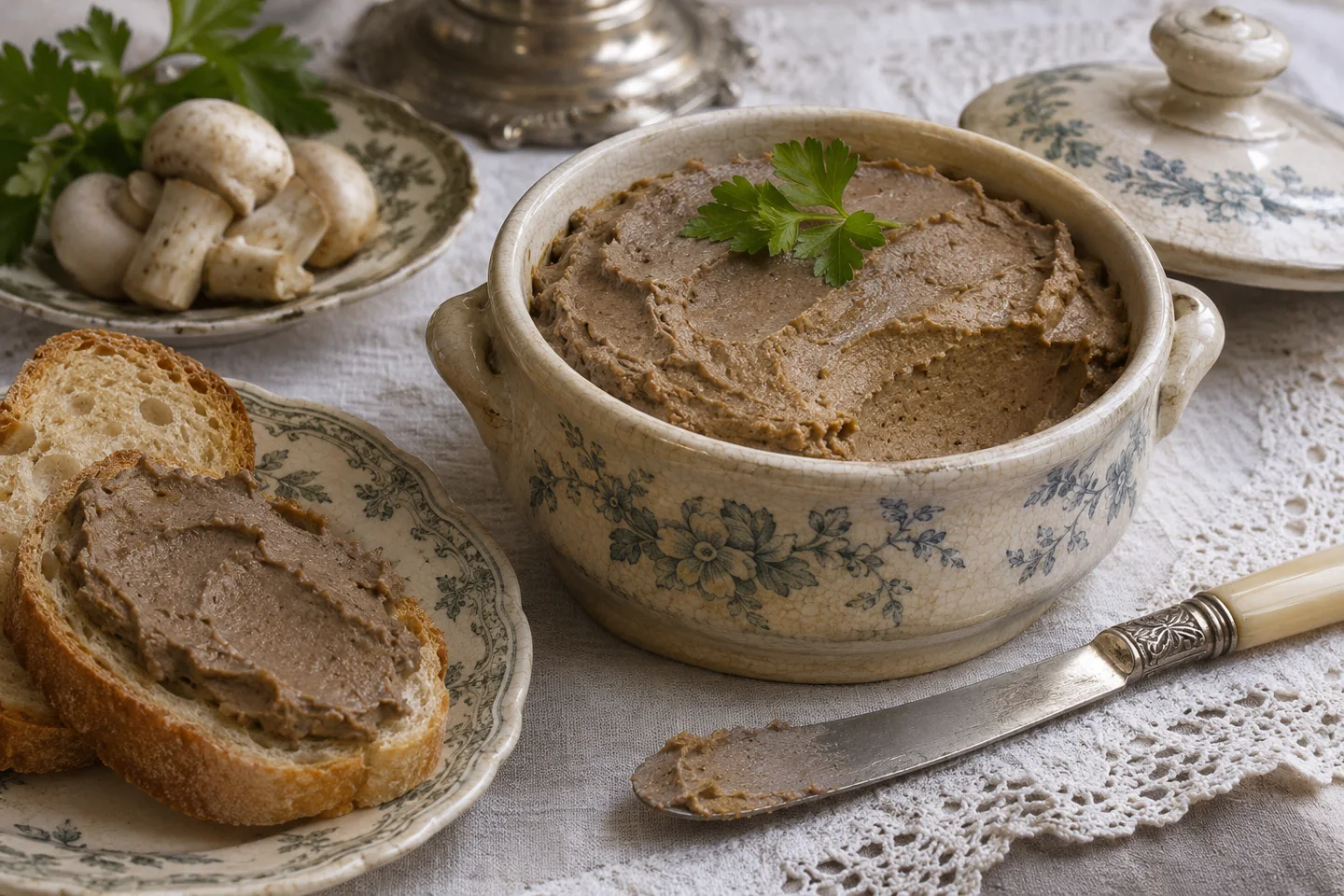
Mushroom cheese may reasonably be compared to a soft, chilled mushroom pâté in which the taste of liver is inseparable from that of the mushrooms. The original does not specify whether it was sliced, spread or spooned from its bowl. A modern artistic reconstruction must identify its chosen presentation as conjectural. An adaptation requires safe ingredients, fully cooked liver and refrigerator storage; historical storage without temperature control should not be reproduced. The great value of the entry is the opportunity to understand an old culinary category through a specific surviving text.
Original recipes and sources
Elena Molokhovets, A Gift to Young Housewives, 1901 edition. Links to scans are available on the original Russian recipe pages.
- No. 3656 — Champignon Mushroom Cheese Spread Russian original
- No. 3655 — Ordinary Tvorog Cheese with Orange Peel Russian original
- No. 3657 — Homemade Pot-Case Cheese Russian original
- No. 3662 — Hare Cheese (Baked Meat Terrine) Russian original
- No. 3663 — Game Cheese or Butter Russian original
- No. 3634 — Liver Butter for Breakfast or Evening Tea Russian original