Mazurek Rising in Cold Water: A Historical Dough Puzzle
Why recipe No. 3110 immersed dough for a thin, dry pastry in cold water and used its floating to indicate that it had risen.
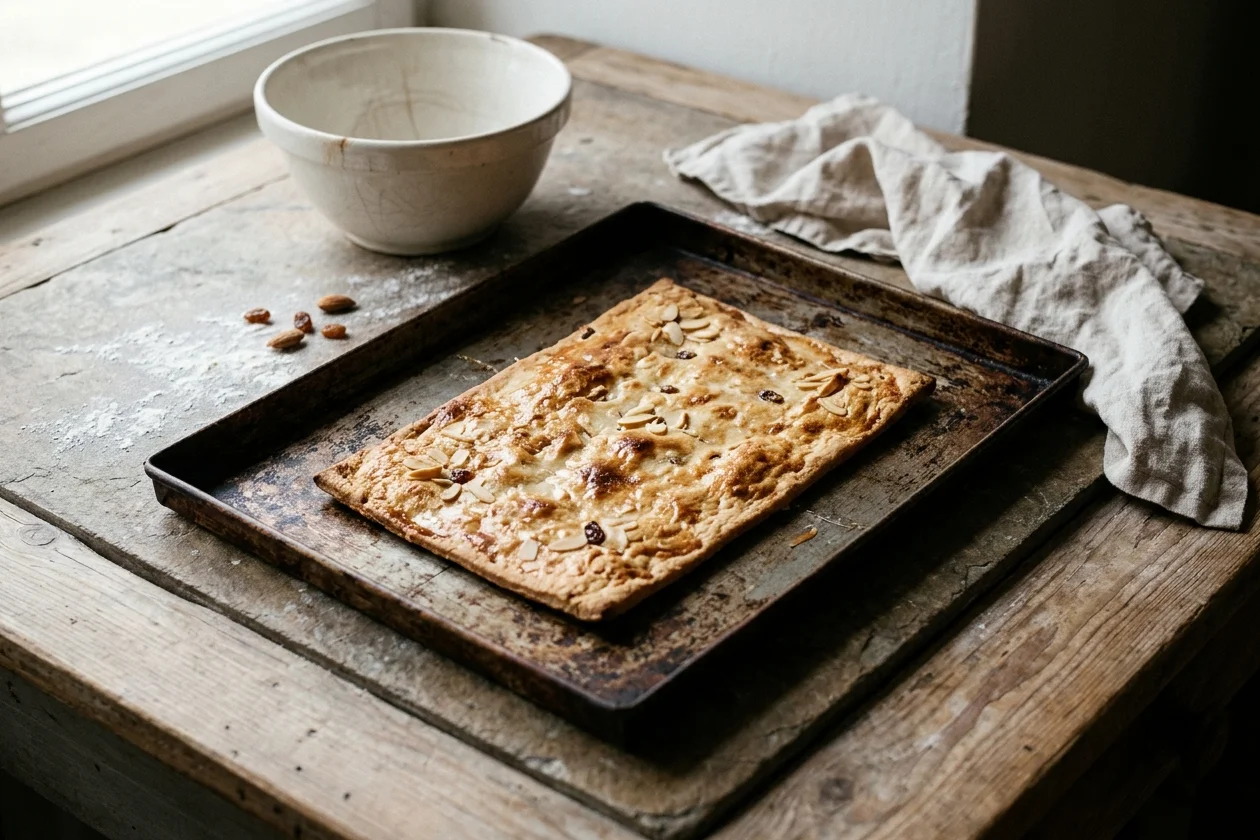
What Molokhovets called a mazurek
Note No. 3106 offers a direct description of the finished product, unusual in old recipes. A mazurek is an elongated rectangular pastry, very thin and dry. It may be glazed, decorated or sprinkled with currants, sugar or almonds, and served with dinner, tea or coffee. An image of a tall rich bun or round cake would therefore contradict the author's general definition. In No. 3110, the most unusual feature is not the finished shape but the treatment of yeast dough before rolling.
What is unusual about recipe No. 3110
The ingredients include milk, yolks, yeast, flour and butter. The mixed dough is placed in a greased cloth, leaving room for it to rise. The original calls for immersion in cold water and identifies floating as the sign that it is ready for further processing. Molokhovets then describes adding sugar, further kneading, rolling thinly and baking. This differs from the familiar method of letting a covered bowl rise in a warm place. We discuss it as historical evidence, not modern guidance for keeping egg-and-milk dough for long periods outside controlled conditions.
Why the dough might have floated
Yeast releases carbon dioxide. Some gas remains trapped in the dough, increasing volume and reducing its average density. When the density of the dough and cloth together falls below that of the surrounding water, buoyancy may change. This is a physical explanation of the possible effect, not an experiment with the historical recipe. Composition, fat content, air, fabric and temperature affect the outcome. Moreover, cold does not accelerate yeast fermentation by itself; lower temperatures generally slow it. Floating is not a universal laboratory test of readiness.
How ordinary yeast mazurek differed
In No. 3107, the dough initially rises in a warm place. After yolks, sugar, anise and salt are added, it is kneaded again, allowed to rise, stretched thinly and placed on a baking sheet. Glazing and additional drying are possible. No. 3109 incorporates beaten egg whites into yeast dough and sprinkles the surface with raisins, almonds and sugar. Neither entry immerses dough in water. The unusual method in No. 3110 is one way of treating dough, not an essential property of all mazureks.
Why the finished pastry should remain thin
The general note emphasizes two features: thinness and dryness. Despite the yeast, the author is not seeking a tall, soft bun. The mixture is stretched or rolled, allowed to cool after baking and dried further if needed. Thin pastry is easier to cut into portions and decorate with glaze. Reference to the size of a sheet of paper suggests a scale, but without knowing the paper format, exact dimensions in centimetres cannot be stated. The illustration should show a low rectangular pastry, not a modern fluffy cake.
What a 'summer oven' meant
At the end of No. 3110, the author mentions a summer oven. This is a historical description of an oven's state or heating regime, which cannot mechanically be converted into a specific modern oven temperature. The source provides no thermometer reading. Similarly, the temperature of the cold water is unspecified. A scientifically precise reconstruction would require comparison with the author's other oven instructions and a controlled experiment. Such details explain why old recipes cannot always become modern step-by-step instructions without further work.
Studying the unusual method safely
Keeping dough containing milk and eggs for a prolonged period requires temperature and sanitary control. Floating does not establish safety or the absence of harmful microorganisms. We do not recommend repeating the described overnight water treatment without a validated modern technique. An artistic reconstruction of a thin, finished mazurek can convey the intention of the dish without purporting to reproduce the exact historical formula.
Original recipes and sources
Elena Molokhovets, A Gift to Young Housewives, 1901 edition. Links to scans are available on the original Russian recipe pages.