Kyiv Dry Preserves: Why Berries and Fruit Were Served in Boxes
Smokvy and Kyiv dry preserves in the 1901 cookbook: draining syrup, drying fruit and coating it with sugar.
How dry preserves differed from ordinary preserves
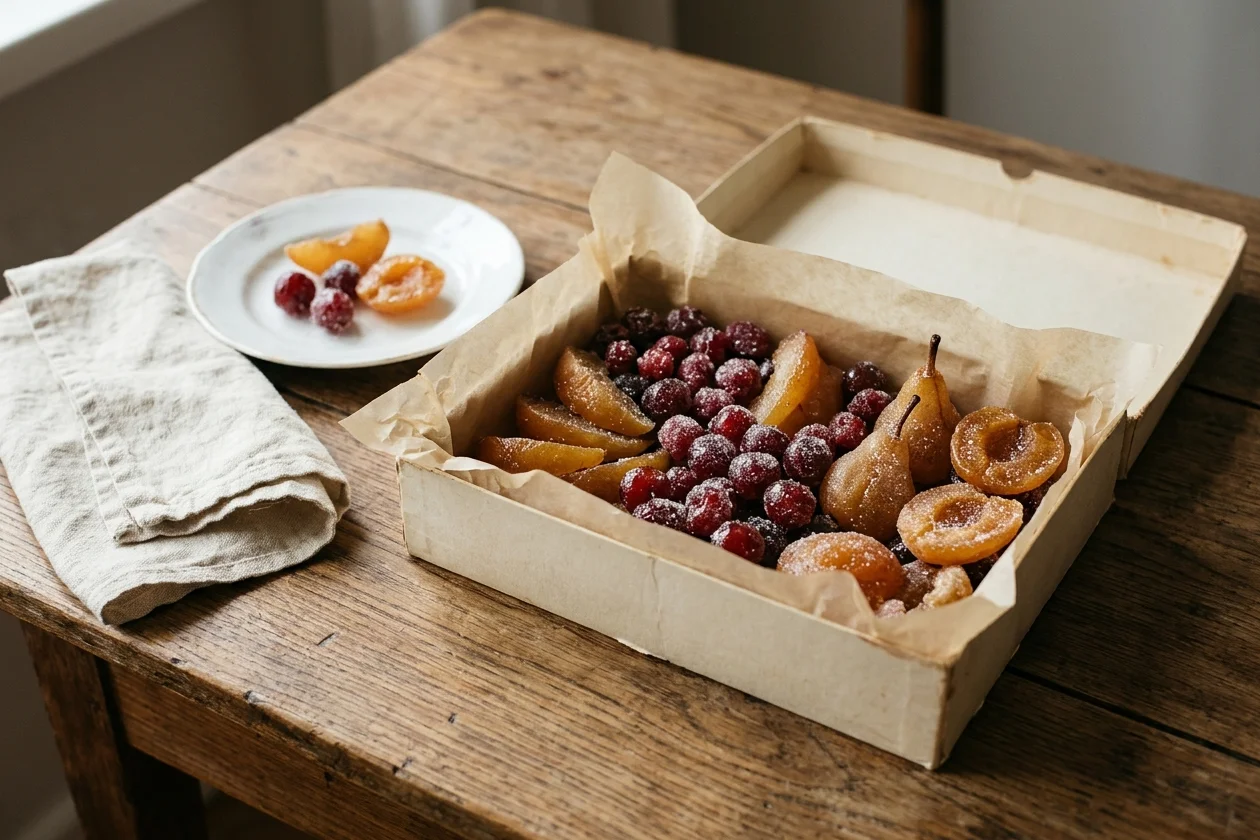
In No. 3887, Molokhovets describes Kyiv dry preserves made from wild strawberries, raspberries, currants, gooseberries, barberries, cherries and several kinds of fruit. After processing, the fruit is dried, coated with sugar and mixed. Unlike preserves served with their syrup, the finished products are individual pieces. They are placed in wooden, tin or cardboard boxes and covered with paper. The name Kyiv reproduces the book's heading, but does not by itself establish where a particular batch was made or how the confection originated.
Why less sugar was used in the syrup
No. 3887 specifies half a Russian pound of sugar per pound of fruit for the initial preserve, instead of two pounds. The general note on smokvy, No. 3885, allows half a pound or one pound. The syrup is nevertheless reduced until thick, and the fruit is treated in it for longer. Reducing the initial quantity of sugar does not necessarily mean that the syrup was thin or the finished product less sweet. Evaporation of water and the additional sugar coating affect the final concentration. The source gives no exact moisture or sugar-content measurements.
How the syrup was separated from the berries
For the Kyiv version the author suggests removing the fruit with a wooden skewer and placing it on a sieve. A bowl of hot water stands underneath, which may help the viscous syrup drain. The berries are then arranged in a single layer and sprinkled with granulated sugar. The important feature is that the liquid is deliberately removed while retaining the shape of individual fruits. Handling them with a wooden implement also reduces direct contact with the sticky berries. This is a characteristic detail of the description, not a sufficient modern food-safety measure in itself.
Apple and pear smokvy
In No. 3709 peeled apples are divided into pieces, combined with bitter orange peel and treated in syrup with cinnamon and cloves. They are dried in the oven. No. 3754 calls for firm pears, first softened in a decoction and then repeatedly dried and coated with thick syrup. In these entries, the word smokvy does not refer exclusively to figs. It denotes a group of sweet fruit products. The apple recipe even permits small fruits to be prepared whole in the same manner as pears.
The assortment of dry preserves
No. 3887 specifically mentions peaches and apricots, whose stones are removed and replaced with peeled sweet almonds. Berries and fruits could be mixed after preparation. No. 3874, for dry rowanberry preserves, likewise calls for draining syrup and coating with sugar. The variety of fruit shapes and colours helps explain the attractiveness of presentation in a box. However, the source specifies neither a standard box weight, exact portion size nor a mandatory assortment, so any reconstruction of the selection remains conjectural.
The historical method and modern limitations
No. 3885 permits the use of leftover preserves, but this does not mean that any old preserve is suitable for reprocessing. Storage claims in historical recipes should not be regarded as validated modern methods. In particular, the claim in No. 3754 concerning prolonged storage of meat stock covered with cotton wool must not be followed. Sweet products require safe ingredients, validated processing and appropriate storage conditions. An artistic reconstruction of a box of candied fruit conveys the serving method, not demonstrated shelf stability.
Original recipes and sources
Elena Molokhovets, A Gift to Young Housewives, 1901 edition. Links to scans are available on the original Russian recipe pages.