Hot Fresh Cucumber Soup: Molokhovets's Barley Purée and Cream
Two cucumber purée soups based on meat or vegetable stock, separate cucumber slices and a pearl barley thickener in the 1901 edition.
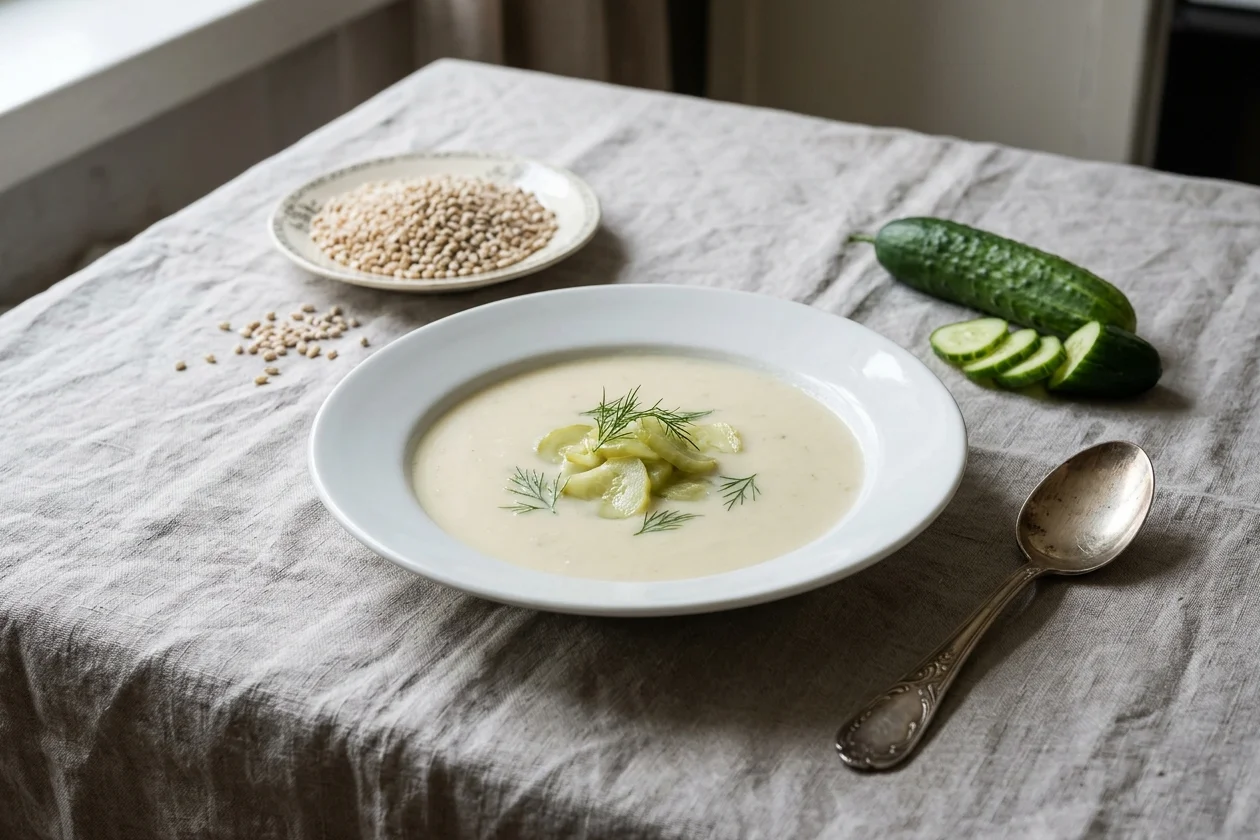
Cucumber soup served hot
Fresh cucumber is often associated with salads and cold soups. Yet Nos. 92 and 146 describe hot purée soups made from fresh cucumbers. In both versions, some of the vegetables are sieved while another portion is cooked separately in slices and placed in the soup tureen. The base also contains toasted flour, pearl barley purée and yolks with cream. This is therefore neither a modern cold cucumber soup nor simply a cucumber decoction. Similar operations recur in two sections of the book, although their initial stocks differ fundamentally.
A meat-based stock with ham
In No. 92, stock is made from chicken and veal shank, skimmed of fat and strained. The cucumbers are divided into two portions: separate slices for serving and vegetables for sieving. The second portion is treated with cooked ham, onion, cloves and a flour thickener. The ham is removed before the final sieving. This detail matters: the meat contributes flavour but does not remain as sieved ham in the finished base. The author does not measure the precise quantity of salt or richness of the stock.
A version without meat or fish
No. 146 specifies a stock of potatoes, root vegetables and herbs. Among additional aromatic plants, the author names tarragon, chervil, currant leaf, savory and rosemary. Washed cucumber peel may be boiled in the stock, while peeled flesh is processed further. Otherwise, the technique resembles the meat version: the vegetable mixture is sieved and combined with barley purée and an egg-and-cream enrichment. This is a dish without a meat or fish base, but not without animal products: cream, yolks and butter are explicitly listed.
Why pearl barley was turned into purée
No. 94 is entitled Purée or Slime Made from Pearl Barley, using the historical term shlem for a viscous preparation. Molokhovets suggests cooking pearl barley until very soft, rubbing it through a sieve while hot and combining it with strained stock. The cucumber soups specifically use purée rather than necessarily having visible individual grains. Components of the cooked grain can give the base thickness and uniformity. The source specifies neither final moisture nor viscosity. A historical amount of dry grain cannot therefore be replaced precisely with a particular volume of modern prepared purée without practical testing.
Why some cucumbers were left in slices
Both soups place separately cooked cucumber slices in the tureen. A sieved base is thereby combined with recognizable vegetable pieces. Dill and pepper are specified for serving. No. 146 contains a discrepancy between the detailed description of cucumber quantity and the ingredient list, so we do not attempt to reduce the entry to one modern weight. The egg-and-cream mixture is heated without boiling in the historical recipes, but this does not establish adequate modern treatment of eggs. Practical adaptation requires a validated safe technique.
Fresh and pickled cucumbers served different purposes
The vegetable soup with pickled cucumbers in No. 2228 is constructed differently: root vegetable stock is prepared separately, parts of the cucumbers flavour the liquid, and flesh and strained cucumber brine are subsequently added. The entry does not turn the entire base into a creamy purée. Comparison helps explain why not every cucumber soup should be called rassolnik. Molokhovets describes both hot sieved dishes using fresh cucumbers and liquid soups using pickled ingredients. An illustration of pale soup with slices and dill is a modern reconstruction of one version.
Original recipes and sources
Elena Molokhovets, A Gift to Young Housewives, 1901 edition. Links to scans are available on the original Russian recipe pages.