Black Bread Soup: Why Molokhovets Browned Sugar and Infused Rye Rusks
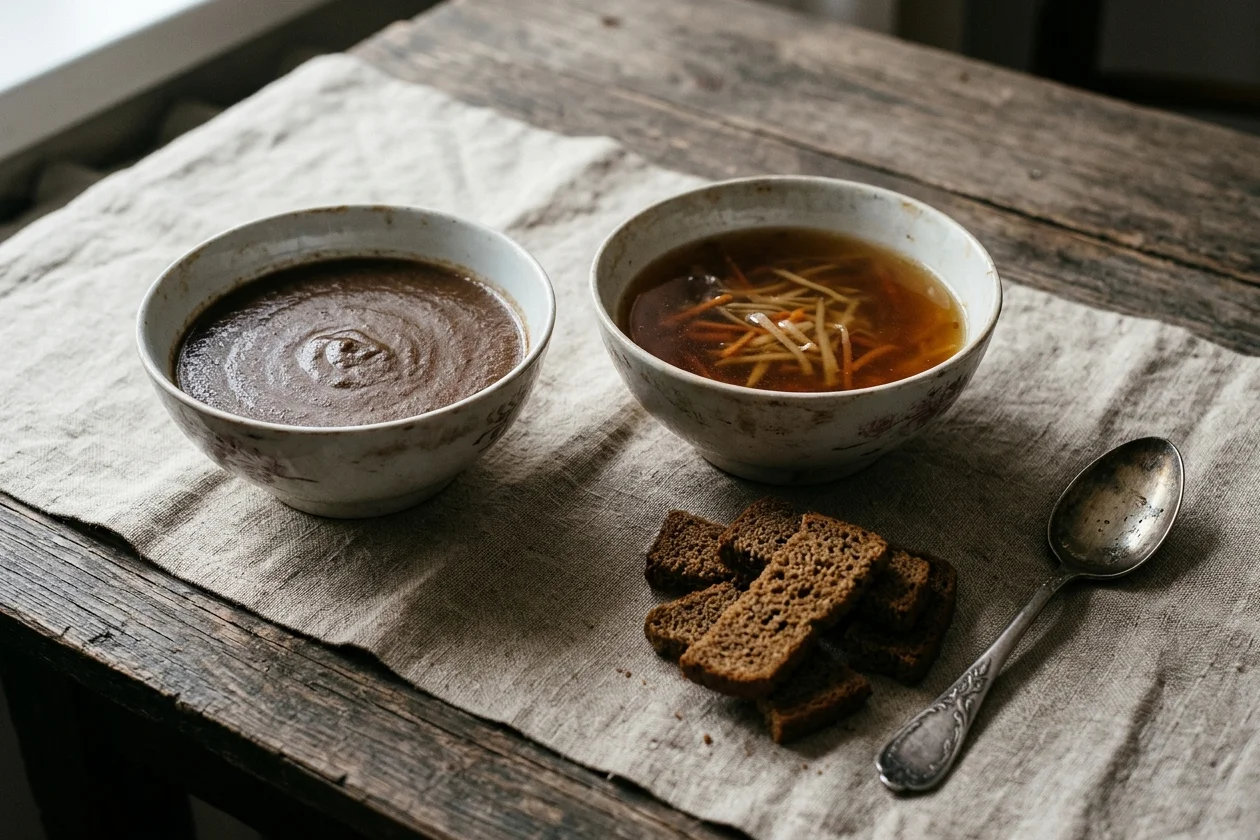
Two different bread soups from 1901: a meat-based purée with Madeira and a vegetable soup made with a strained rye bread infusion.
Two soups from one ingredient
In No. 101 of the 1901 edition, bread becomes a sieved mixture in meat stock, whereas No. 2223 uses bread to prepare a separate infusion that is subsequently strained. Both recipes use black rye bread, but their results differ primarily in structure. The first is called a purée soup and contains processed bread crumb. In the second, vegetables and herbs take centre stage while bread contributes to the liquid. Bread soup should therefore not be understood as one single traditional recipe.
Stale crumb and meat stock
In No. 101 finely crumbled bread crumb is stewed with butter under a lid, diluted with beef stock and rubbed through a sieve. This keeps the bread within the mixture. Starch in previously baked bread can bind liquid, while fine particles affect thickness and uniformity. The author specifically uses stale crumb; fresh crust and rusks are not named here. Madeira or sherry is added at the end. The exact remaining alcohol content is unknown, and heating does not guarantee complete removal.
Why two pieces of sugar were browned
In the same entry, Molokhovets describes a separate technique: to give the soup a dark colour, sugar is heated in a small frying pan, diluted with stock and only then is wine added. This explicitly indicates the desired colour. Strong heating of sugar may produce dark compounds through caramelization and more extensive thermal decomposition. But the author specifies neither temperature nor acceptable degree of darkening. The historical operation should not be treated as advice to char sugar or repeat it without a safe modern technique.
How bread infusion was made for vegetable soup
No. 2223 begins with a stock of carrots, parsley, celery, onion, leek and herbs. Some of the roots and onion are fried beforehand. Dried slices of rye bread are separately covered with hot strained stock; after infusion, the liquid is separated from the bread again. It is added to the vegetable soup before serving. Unlike No. 101, this recipe does not require bread to be rubbed into the main mixture. Rusks can thus impart flavour and colour without necessarily becoming a thick component of the finished dish.
Root vegetables, spinach and cutting technique
The vegetable recipe lists carrots, galarepa or young sweet turnip, celery, asparagus and dried green peas. The roots are cut finely, like vermicelli. Spinach leaves and dill are added immediately before serving. This is a completely different composition from the meat-based bread purée. Molokhovets also permits lightly frying the shredded roots beforehand. Exact cut dimensions and stock colour remain unknown; galarepa in this context is related to the name kohlrabi, though the author allows another vegetable as a substitute.
One bread, several methods of extracting flavour
Bread infusion also appears in the previously discussed black bread ice cream. There some rusks impart aroma to the liquid while another portion of bread remains in the frozen mixture. Comparison with these two soups shows the different functions of a single ingredient: it can thicken, impart flavour or combine both roles. This is a more informative conclusion than a general claim about thrift, because it rests on specific operations in the book. An artistic reconstruction of two bowls may show their structural differences, but colour and density should not be presented as precisely established.
Original recipes and sources
Elena Molokhovets, A Gift to Young Housewives, 1901 edition. Links to scans are available on the original Russian recipe pages.