Candies Made from Fresh Roses: How Molokhovets Decorated Sweet Dishes with Flowers
Candied roses, glazed berries and shaped tragacanth sweets: three branches of domestic confectionery in 1901.
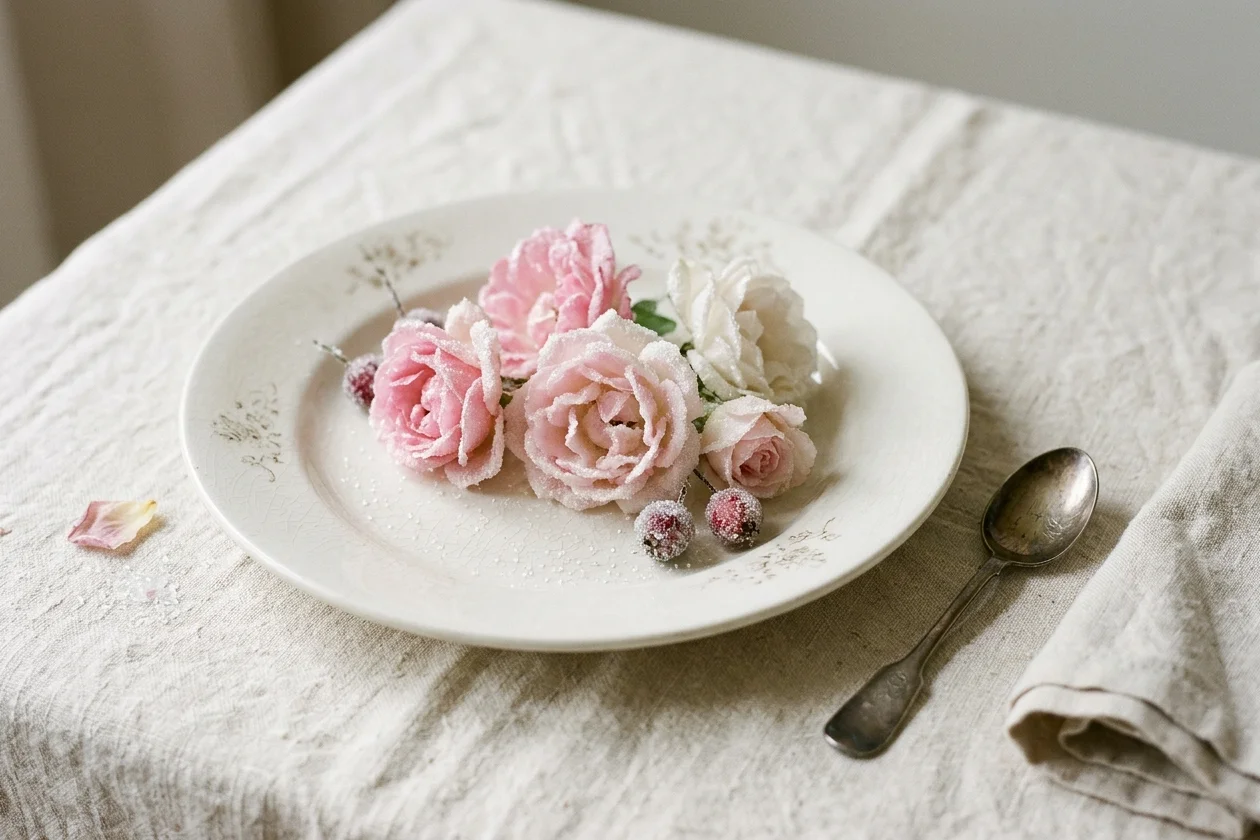
Roses were not only a flavouring
In No. 3844, Molokhovets describes candies made from fresh roses. Fragrant scarlet or white centifolia roses are preferred. The author aims to preserve the appearance of the entire flower and cover it with fine sugar. The finished pieces are intended to decorate cakes and dishes of fruit and grapes. This distinguishes the entry from syrup or preserves made from individual petals, where the original flower shape generally ceases to be the principal decorative feature. The text confirms the purpose of the confection, but does not establish the exact appearance of the finished sugar crystals.
What cherry gum meant
For the rose coating, No. 3844 mentions powdered cherry gum, which the author suggests obtaining from a pharmacy, and rose water. This is a historical adhesive substance rather than modern stationery or industrial glue. The term is associated with plant gum, although the exact chemical composition of the pharmacy product is not established in the recipe. Its described purpose is to form a viscous liquid that holds sugar on the flower surface. An industrial adhesive or non-food substance must not be substituted for the historical ingredient.
Why the whole flower's shape mattered
The entry emphasizes careful handling of the roses: the author aims to coat the flower evenly and remove excess liquid. Fine sugar is sifted through thin cloth. This shows that the decorative surface was an important part of the conception. Molokhovets's explanation of the effect of the sun's warmth and the formation of small crystals cannot automatically be treated as a modern scientific account. An exact reconstruction would require further information about the composition of the coating, air humidity and sugar. An illustration may convey the general impression of a candied rose without confirming every detail of the method.
Cranberries and cherries in white glaze
Nos. 3839 and 3760 describe cranberry and cherry candies. Unlike roses, the berries are coated in a glaze based on egg white, fine sugar and lemon juice. The author lets the pieces dry and explicitly warns that they cannot be stored for long. White glaze may conceal the natural colour of a berry while retaining its recognizable rounded shape. These entries illustrate a different decorative coating, unrelated to plant gum. A modern adaptation requires a safe glaze made with pasteurized egg white and appropriate refrigeration.
Figures made from tragacanth paste
No. 3891 describes another technique. A sugar paste containing tragacanth is used to make shapes resembling wild strawberries, mint lozenges and mushrooms. Wild strawberries are represented by shape and colouring rather than being an obligatory fruit ingredient. Mushrooms are assembled from separate parts of the paste, with stalks and caps of different colours. Thus the book describes both preserving the natural form of an actual flower or berry and creating an artificial edible figure. This distinguishes decorated raw material from modelled confectionery decoration.
How to read these recipes safely
Historical names of pharmacy ingredients and aromatic oils are not sufficient grounds for using them today. Edible decorations require reliably edible flowers grown for food use, without non-food treatments, and appropriate food-grade ingredients. Ordinary florist bouquets are unsuitable. Storage times given in the old book do not establish modern safety. The value of the article lies in the differences among decorative methods and in understanding why the author retained a flower's natural shape. An artistic illustration cannot replace a validated preparation technique.
Original recipes and sources
Elena Molokhovets, A Gift to Young Housewives, 1901 edition. Links to scans are available on the original Russian recipe pages.