Why Buzhenina Was Prepared with Hay and Dark Beer
No. 966 describes two stages of pork preparation: a brief preliminary boiling with fragrant hay fragments, then braising in dark beer. A look at the historical technique.
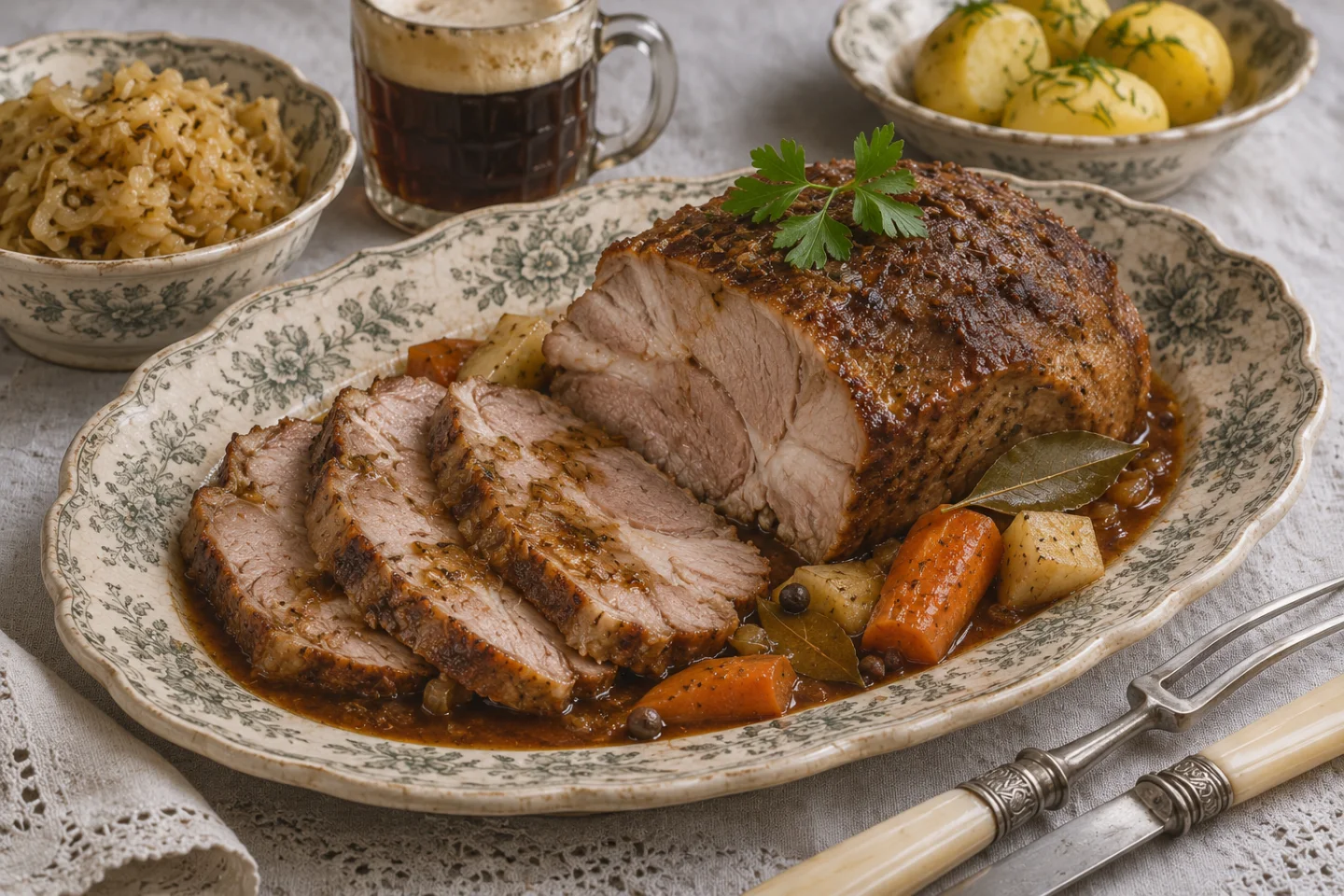
Not roasting pork in hay
The unusual title of No. 966 might suggest that pork was roasted under a blanket of hay. Molokhovets describes something else. A piece of hind leg was tied in a cloth and put into cold water with two large handfuls of fresh, fragrant hay fragments, then brought to the boil. The pork was removed from the cloth and transferred to another stage: braising with spices and roots in dark beer. Hay appears in the preliminary treatment; it is not a garnish or stuffing. This distinction is essential to understanding the historical title.
What hay fragments meant in this recipe
Hay fragments are small particles of dried grass left when hay is handled. Molokhovets emphasizes freshness and fragrance. They may have been used for aroma or for some aspect of preliminary meat treatment, but the author does not explain the chemical action of the herbs or why this stage was required. The exact plant composition, provenance and extent of aroma transfer to the pork cannot be reconstructed. There is no reason to promise that a modern handful of arbitrary hay would have the same effect.
What happened after boiling
The meat was removed from the cloth and placed in a saucepan with bay leaf, allspice, ordinary pepper, roots and a bottle of dark beer. It was braised under a lid until done. Unlike dry roasting, this method cooks the meat while forming a liquid for serving. The author suggests skimming fat from the sauce and thickening it with flour if needed. The historical Russian expression 'English pepper' usually meant allspice. This does not imply that the historical dark beer was identical to a particular modern stout or porter.
How the neighboring buzhenina recipe differed
No. 965 describes buzhenina as the leg of a young pig roasted on a baking sheet on two crossed wooden splints. It has neither the preliminary hay treatment nor beer braising. The adjacent entries show different ways of preparing the same ingredient. The word 'genuine' in the title of No. 966 is part of the author's heading, not evidence that every other form of buzhenina was inauthentic. The next entry, No. 967, pairs roast pork with prune sauce, another combination of meat and a distinctive sauce.
What Molokhovets served with buzhenina
At the end of No. 966, the author lists accompaniments: chestnut sauce, with references to Nos. 565 and 566; Lithuanian-style braised cabbage (No. 553); and boiled potatoes (No. 604). These links place the dish within the structure of the book rather than treating it as an isolated curiosity. The chestnut recipes include a purée and a red-wine sauce; cabbage and potatoes offer different accompaniments. The author does not require all of them to be served together. The numbered references show how the book helped the cook assemble a dinner.
Can the historical technique be reproduced today?
Ordinary agricultural hay is not a food ingredient: it may contain contaminants, dust, mould and unidentified plants. It should not be used to reproduce the recipe. A safe modern interpretation could use pork braised with food-grade spices, root vegetables and beer, clearly identified as an adaptation without hay fragments. Doneness should be assessed under modern food-safety rules, rather than solely by the historical instruction to braise until ready. This preserves respect for the source without importing obsolete domestic practices literally.
Original recipes and sources
Elena Molokhovets, A Gift to Young Housewives, 1901 edition. Links to scans are available on the original Russian recipe pages.
- No. 965 — Buzhenina: Roast Ham of Young Pork Russian original
- No. 966 — Traditional Buzhenina with Fragrant Hay Dust and Dark Beer Russian original
- No. 967 — Pork Roast with Prune Sauce Russian original
- No. 565 — Chestnut Purée Russian original
- No. 566 — Chestnut Sauce with Red Wine Russian original
- No. 553 — Lithuanian-Style Stewed Cabbage Russian original
- No. 604 — Boiled Peeled Potatoes Russian original