Beef Stroganoff in Molokhovets: Why Mustard Was Added to the Sauce
Original recipe No. 798 from the 1901 edition: small squares of beef, stock, sour cream, Sarepta mustard and tomato.
What beef Stroganoff was called in the book
No. 798 in the 1901 edition is entitled Beef Stroganoff, with Mustard. The title immediately singles out one of the flavourings in the sauce. The recipe does not coincide in every detail with the modern restaurant version, although the combination of beef and sour cream remains recognizable. We are examining the 1901 edition specifically: the presence of the entry in this edition does not prove that the recipe first appeared then or that the author personally invented the dish. Establishing its origin requires comparison with earlier editions and independent historical evidence.
Small squares rather than long strips
Molokhovets suggests taking tender beef and cutting it into small squares. This is a noticeable difference from today's familiar long, thin strips of meat. The source does not specify the dimensions of the squares, so this observation should not be turned into an exact standard in centimetres. The meat is seasoned with salt and pepper beforehand. The ingredient list specifies three Russian pounds of beef for the dish. This large historical quantity does not automatically correspond to one modern portion; the entry does not specify the number of diners.
The sauce was prepared separately
The sauce begins with butter and flour, lightly fried and then diluted with two glasses of stock. Prepared Sarepta mustard and pepper are added. The mixture is strained, and before serving, two tablespoons of fresh sour cream and a spoonful of previously fried tomato are incorporated. This is therefore not simply sour cream in which meat is stewed. The base is stock with a flour thickener, supplemented by dairy and tomato. Mustard is explicitly named both in the heading and in the ingredient list.
The meat and sauce were combined at the end
The beef is fried separately with butter and onion, then transferred to the prepared sauce. The author specifies a brief final heating under a lid at the edge of the stove. This distinguishes two operations: developing the meat's flavour and colour during frying, then combining it with the liquid base. The precise conditions of the historical stove are unknown, so the expression 'over high heat' cannot be converted into a guaranteed temperature for a modern burner. A modern adaptation requires safe storage conditions and adequate heat treatment of the beef.
How neighboring beef recipes differed
No. 797, Viennese-style beef fillet, is cooked as a large piece; sour cream is involved in treating the meat and in the sauce made from its juices. No. 799 specifies fillet with truffles or anchovies, and No. 800 describes roasting fillet in paper and serving it on a dish. Unlike these, No. 798 begins with finely cut meat and a separately prepared stock-and-flour base. Comparison shows the importance of mustard sauce and the cutting method in this particular entry. Historical uses of paper and open fire should not be transferred mechanically to the modern kitchen.
What the finished dish might have looked like
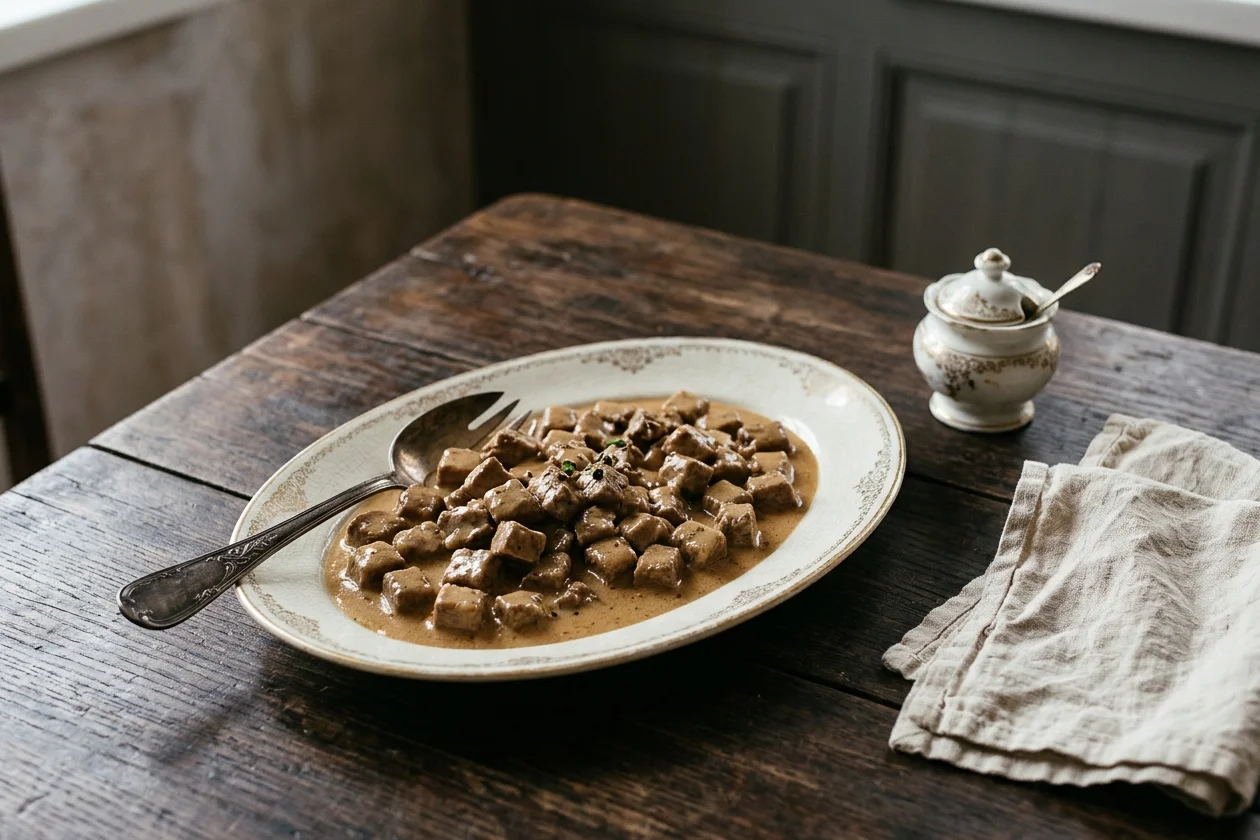
No. 798 specifies no mandatory accompaniment. Fried potatoes, rice or pasta cannot be attributed to the source, although they are possible modern choices. The main text suggests small pieces of meat coated with sauce. Its shade depends on the stock, fried tomato and browning. No precise historical photograph is available, so the illustration is identified as an artistic reconstruction. The value of the entry is that it allows comparison of a familiar modern dish with a specific historical composition without replacing the original with later conventions.
Original recipes and sources
Elena Molokhovets, A Gift to Young Housewives, 1901 edition. Links to scans are available on the original Russian recipe pages.
Related reading
- How Dinner Was Planned in 1901: Time, Preparations and Kitchen Labour (in Russian)
- Cinnamon, Cardamom and Vanilla: Spices in Molokhovets’ Kitchen
- Dining Outside the Home: Taverns, Cookshops and Dining Rooms in St. Petersburg around 1901 (in Russian)
- Hot Forshmak: Herring, Meat and Potatoes in a Single Bake