Genuine Green Cheese: Why Molokhovets Used Horseradish Leaves
Recipe No. 3661 explains an unusual homemade cheese coloured with horseradish leaf juice, sour cream and a mysterious herb called fenum grecum.
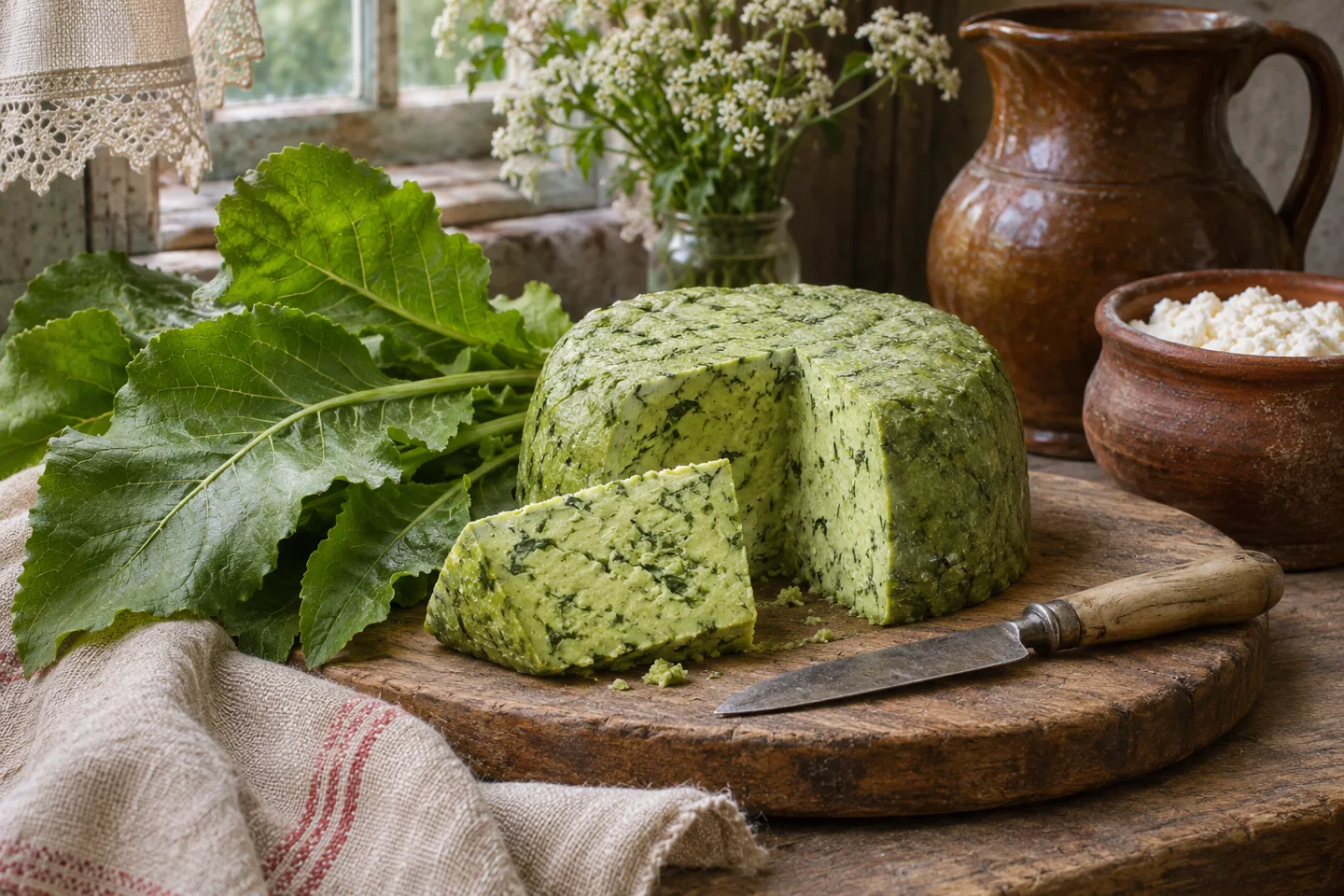
Green cheese, not mushrooms or mould
In No. 3661, Molokhovets gives a recipe for 'Genuine Green Cheese'. Its peculiarity is not the absence of dairy, as in mushroom cheese, but the addition of plant ingredients to an already prepared dry cheese. The source refers to homemade cheese No. 3649. It lists sour cream, horseradish leaves and a herb with the Latin-like name fenum grecum. This ingredient list lets us discuss the plant origin of the colouring without depicting a cheese ripened with green mould.
How horseradish leaves were used
Unlike familiar grated horseradish root, No. 3661 calls for leaves. They are pounded, the liquid is pressed through a cloth and allowed to settle. The author distinguishes the watery top from the thicker residue, which is combined with sour cream and sieved dry cheese. The mixture is to acquire a curd-like consistency. Using the thick residue may have transferred plant particles and colouring, but the book offers no chemical analysis or plant variety. It cannot promise a modern reader a particular shade of green.
What fenum grecum may have meant
A note in the digital recipe associates this name with Trigonella foenum-graecum, fenugreek or Greek hay. The identification is plausible, but the spelling in the source and absence of further botanical information prevent treating it as definitive. The exact part of the plant, preparation or variety used is unclear. We preserve the original term and distinguish the interpretation from it. Substituting modern fenugreek seeds for the historical herb cannot automatically be said to match the entry exactly.
Why an already prepared cheese was grated
No. 3649 describes a simple homemade cheese made from soured milk without sour cream, with salt and caraway. No. 3661 does not begin with fresh milk: dry cheese is grated and sieved, then combined with sour cream and the plant ingredient. This is the reworking of an existing dairy product rather than forming a new curd directly from milk. By comparison, No. 3659 curdles cream using vinegar, while No. 3660 combines fresh curd cheese with butter. These different starting structures reveal the range of household processes covered by the word cheese.
Maturation and shaping in the historical account
After mixing, Molokhovets describes stages of resting, further stirring, light pressing and drying. The transformation from a curd-like mixture into a firmer product is noteworthy. However, no measurable temperature, acidity or microbial control is specified. This part of the recipe is evidence of a household technique, not safe modern guidance. We do not suggest keeping a sour-cream cheese mixture warm, drying it without controlled conditions or repeating the storage periods given in 1901.
Why green cheese deserves separate study
Earlier stories about hare cheese and mushroom cheese concern appetizers whose names do not denote ordinary dairy cheesemaking. Green cheese retains a dairy base and is distinguished by plant additions and subsequent processing. Similar headings should not conceal differences in recipes. Even within the same section there are products based on cream, curd cheese, meat, mushrooms and game. Studying green cheese separately clarifies the relationship between plant colour and dairy base without repeating the account of meat pâtés.
Where evidence ends and reconstruction begins
The text gives ingredients and a historical description of the process, but no surviving sample. An illustration may suggest a firm cheese with a muted green hue and plant flecks nearby; it cannot establish the exact colour or shape. A modern analogue should use a professionally or industrially controlled dairy base and edible herbs rather than reproducing the old maturation process.
Original recipes and sources
Elena Molokhovets, A Gift to Young Housewives, 1901 edition. Links to scans are available on the original Russian recipe pages.
- No. 3661 — Genuine Green Cheese Russian original
- No. 3649 — Ordinary Homemade Caraway Cheese without Sour Cream Russian original
- No. 3660 — Butter-and-Tvorog Cheese for Tea or Breakfast Russian original
- No. 3659 — Cream Cheese for Tea or Breakfast Russian original
- No. 3656 — Champignon Mushroom Cheese Spread Russian original