Section XXXVII: Serving the Table — Appetizers, Formal Dinners and Historical Place Settings
Complete English translation of Molokhovets’ 1901 chapter on formal and informal table settings, appetizer service, suppers, napkin folding, and 13 original illustrations.
A) ARRANGING A TABLE FOR APPETIZERS.
1. Near the dining-room door, or in an adjoining room if space permits, set a separate table for appetizers.
2. Around the edge of a round table covered with a tablecloth (see illustration A below), set small plates of assorted appetizers, sliced thinly: cheese, whitefish, salmon, ham, corned beef, roast game, sausage, as well as lobster, caviar, grated green cheese, grated corned beef, herring pulled into pieces and dressed with mustard sauce, and so forth.
3. At two opposite points, a little higher than the appetizer plates, place dishes of bread and rolls cut into thin slices; at the two other points put butter dishes of the freshest butter, which may be unmolded from wooden forms onto small plates.
4. At two opposite ends or corners of the table put dishes holding napkins, and at the other two ends put dishes of forks.
Fold the napkins into triangles: put the first with its corner pointing toward the middle of the table, the second with its corner to the left and the third with its corner to the right. Arrange the second, third and fourth rows in the same way. Knives and forks are placed directly on the napkin.
5. In the middle of the table put an attractive cruet set, for example of colored glass, holding two or three kinds of vodka in pitchers or small decanters with little cups hanging around a woven stand. Alternatively, set out ordinary vodka decanters surrounded by small glasses.
B) A MORE ELABORATE APPETIZER TABLE CAN BE ARRANGED AS FOLLOWS.
1. In the middle of a rectangular table (see illustration B below), place a revolving tray containing six shallow salad bowls of different appetizers. In its center put a seventh similar bowl filled with thin slices of bread.
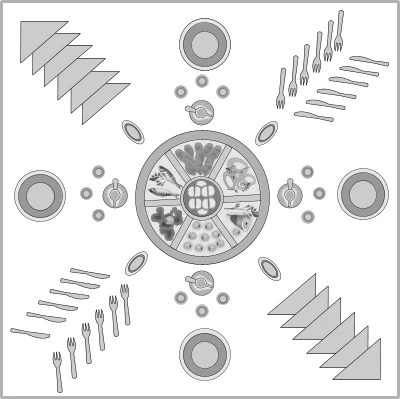
2. Along the four sides of the table, in the middle of each edge, set four stacks of small plates, three or six plates in each.
3. On two opposite corners place napkins folded into rectangles or triangles, each about half a vershok lower than the preceding one, right down to the table corner, as shown in the illustration.
5. Between the revolving tray and the stacks of plates put vodka and glasses, in small barrels, pitchers or decanters.
6. Between the vodka decanters set butter turned out of molds onto small plates or butter dishes.
C) ARRANGING A FORMAL DINNER TABLE.
Note. The setting and decoration of a table can vary with the occasion, the number of guests and therefore the size of the table, as well as the season and time of day. Let us take a formal dinner as an example.
1. In the center of a table covered with a snow-white tablecloth (see illustration C below), place a silver or glass tiered stand containing fruit, sweets and flowers. Such stands can be very luxurious and costly, but they can be replaced by a less expensive arrangement made as follows:
Take three more or less ordinary glass or crystal vases, each smaller than the last, but all of the same kind. Stand them one above another.
Cover the stem of the bottom vase with artificial or fresh flowers, their roots directed upward so that the blossoms lie on the table and form an even circular bed. The stems should be three to four vershoks long; tie the root ends around the vase stem.
Tie similar flowers to the upper part of the same stem, but only two to two and a half vershoks long, with their root ends pointing down. The upper and lower stems should thus be concealed among the blossoms and bound with a velvet band or ribbon in a Bordeaux red shade, finishing in a cluster of loops.
Arrange oranges and mandarins on the lowest vase, interspersed with trailing sprays of grapes. On the second vase put apples, pears, bergamots and the like, also interspersed with hanging grape branches.
Put sweets into the third vase.
In the highest vase, which should be deep and shaped like a broad goblet, pour water and arrange a magnificent bouquet of white or lilac-colored lilacs, lily-of-the-valley, varied fresh flowers, dangling fuchsias and greenery. If these are unavailable, use a bouquet of very good artificial flowers.
2. Along both sides of this tiered centerpiece put one, two or three additional colored flower vases, arranged from higher to lower.
If the dinner takes place under evening lighting, place candelabra with candles or lamps on either side of the centerpiece, then a flower vase beyond them, depending on the length of the table.
3. In front of each place setting, opposite the plate and beyond the glasses, put a small vase or tall glass holding a fresh bouquet. These bouquets may be placed at every setting, or only before the newly married couple when the dinner is in their honor, or only before the woman celebrating her name day—in short, before those in whose honor the dinner is given.
4. Arrange as many flat dinner plates around the table as there will be guests. Avoid crowding people if possible; allow one arshin of table space for each person.
5. Beneath each plate put a napkin folded into an even rectangle and pressed into a triangle. One corner should lie under the plate and another, bearing a richly embroidered monogram, should hang down from the table.
6. To the left of each dinner plate place a small bread plate with one one-kopeck piece of finely sifted rye bread, one one-kopeck French roll and a slice of black bread. The little pies served with the soup are also placed on this plate.
7. To the right of the plate lay a knife and fork, and diagonally above them a spoon.
8. At large dinner parties, crystal or silver knife rests are not set out, since it is customary after each course to leave the used spoons, forks and knives on the plates when they are cleared. Only clean things are continually placed on the tablecloth.
9. In front of the plate set drinking glasses, small wine glasses and a goblet of different sizes.
10. For every place setting, or at least for every two settings, put a small crystal saltcellar containing fine salt, or a double saltcellar containing salt and pepper.
11. Across the table, on both sides of the fruit centerpiece, set holders filled with fruit knives made of bone, silver or gilded metal, handles upward.
12. On either side of these holders put small water pitchers: the more of them the better, provided all are of one size.
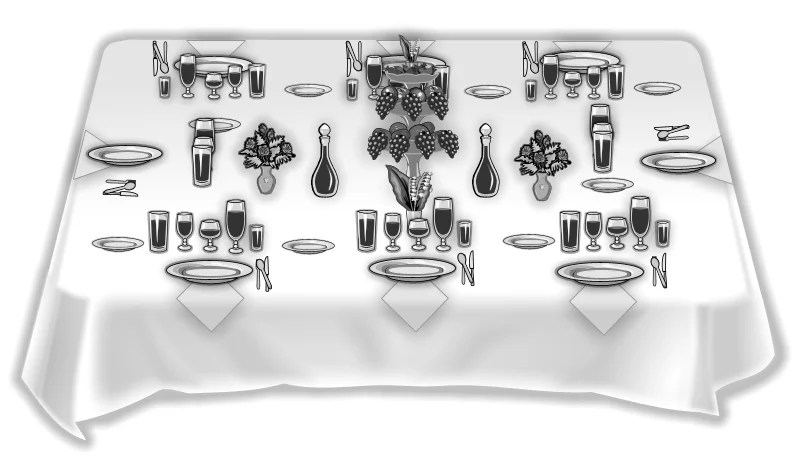
13. In the center of the table, between the flower vases, place bottles or pitchers of wine in pairs, as desired.
14. Recently it has become fashionable to eat all sweet dishes, even ice cream, with a fork rather than a spoon. But this fashion will probably soon cease, since it is not merely inconvenient but harmful: ice-cream enthusiasts are forced to swallow it too cold, because once it melts slightly they can no longer pick any up with their forks.
15. Near the door through which the courses are brought, set a table of clean plates and cutlery, and a separate small table of beer, kvass, mead and various wines.
16. The waiter should quickly remove plates with soiled spoons, knives and forks and immediately replace them with clean ones.
17. Always serve courses from the left, beginning with the ladies and finishing with the gentlemen.
18. Wines are served at the table as follows: champagne well chilled, Burgundy and Lafite warmed, and the others cold.
Warm wine by standing the bottles in hot sand before dinner, while champagne is kept in metal ice buckets.
Uncork the bottles skillfully, without noise and without splashing the seated guests.
After the sweet course, serve cheese sliced thinly; only after that serve the fruit and sweets.
A quarter of an hour after dessert, once the guests have risen from the table, serve black coffee without pastries, accompanied by a tiny glass of sweet, syrupy liqueur.
D) A SIMPLER DINNER TABLE SETTING.
1. Put vases or flowerpots with living flowers of different colors in the middle of the table, beginning with hyacinths.
If matching attractive flower vases are unavailable, use simple flowerpots of the same size. Cover the lower part of each with a sheet of delicate pink, pale green or even white tissue paper, tying the four corners near the root of the flower with a matching white, pink, green or Bordeaux-colored ribbon, complete with a bow and trailing ends. Spread the corners of the tissue evenly upward in all four directions like a standing collar around the flower. These plain sheets of tissue paper can be replaced, and even improved upon, by inexpensive Chinese lampshades (15 kopecks per pair), into which the flowerpots may be inserted. If there are two pots they should be of equal size; if there are three or five, the middle one should be taller than the others.
2. On either side of the flowers, at a suitable distance, place a vase of fruit or berries—wild strawberries, garden strawberries, raspberries and so forth—according to the season.
3. Set the table in the same way as for the formal dinner, but omit the individual flowers in front of every setting and use fewer water pitchers, wines and the like. Otherwise everything remains the same. Napkins may be folded in the same fashion or differently; see the end of the following page.
E) ARRANGING A SUPPER TABLE.
A formal supper is set out in the same way as dinner, while a more intimate family supper is arranged as follows:
1. Set a separate table for appetizers, as in illustration A or B.
2. On the main table prepared for supper, omit the fruit centerpiece, because fruit and sweets will have been served during the evening. Instead place flowers or a large candelabrum with several candles or three to five lamps.
3. On either side of the flowers or candelabrum set two small round dishes of equal size containing sweet courses: cake, cream, jelly and so forth.
4. Beside these, on both sides, place two medium-sized oblong platters of roast meat.
5. Beside them, on both sides, place two long platters of historical mayonnaise-style fish, suckling pig or game; or one platter of that dish and another of plain boiled salmon with sauce or similar food.
6. Between these platters place bottles or pitchers of water and wine, on silver or papier-mâché stands.
7. Arrange plates for the mayonnaise-style dish around the table.
8. Set sauceboats containing sauce for the mayonnaise-style dish at four places on the table.
9. Place forks for the mayonnaise-style dish to the right of the plates.
10. Between every two place settings put a saltcellar.
11. In front of each setting put small wine glasses, drinking glasses and, if necessary, champagne goblets.
12. Between each mayonnaise-style platter and the roast put two stacks of plates for the roast. On the two spare top plates lay the knives and forks appropriate to the course.
13. Between the roast platter and the sweet dish put dessert plates for the sweet course at four places. Lay suitable small forks or dessert spoons on the spare top plates.
14. In general, avoid using mismatched tableware. All the dishes should have the same color and pattern; only the plates for dessert or the final sweet course may have distinctive fashionable patterns, pictures and inscriptions. Some variation is permissible, but only in the following way: the platters and all plates for the mayonnaise-style course should match; the platters, salad bowls and plates for the roast should be a second matching set; and the serving dishes and dessert plates for the sweet course should be a third.
The same arrangement can be observed with knives and forks: silver ones for one course, bone-handled ones for another, and so forth.
15. At an informal supper among family and friends, beginning with the mayonnaise-style dish, the hostess at one end and the host at the other serve the guests themselves, exchanging their own plates for those of the guests.
As soon as one dish has been distributed, the serving platter is removed at once and the second dish brought to the hosts.
When the servants have cleared away all used plates, knives and forks, the guests themselves take the clean plates, knives and forks that have been placed in front of them for the second course.
The same procedure is followed for the third course.
16. When setting a dinner table, napkins are folded into different shapes and placed on the plates. For this they must be lightly starched; when ironing, take care that they do not become skewed but retain a square shape. They should still be slightly damp when folded and be of a fairly large size, otherwise they cannot be made into tall shapes.
First, the simplest form: fold a small napkin into a triangle.
Second form: fold the napkin into a triangle, tuck both corners inward and place slices of bread inside.
Third form: place a corner of the napkin beneath the plate, leaving the opposite corner, embroidered with a handsome monogram, hanging over the edge of the table.
Fourth form: fold the napkin into an envelope so that two small triangular pockets form in the center; place the bread inside these pockets. A corner on one side may also be raised and another slice of bread tucked underneath it.
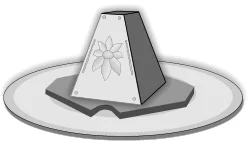
Fifth form: napkins may also be folded into tall shapes called pyramids, cardinal's hats, fans, screens, candelabra, wedding napkins and the like.
F) EXAMPLES OF PRESENTING SERVING DISHES.
I include several illustrations here as examples of presenting dishes, since an attractive presentation gives the food greater value and stimulates the appetite.
Figure No. 1 shows how to roll out dough.
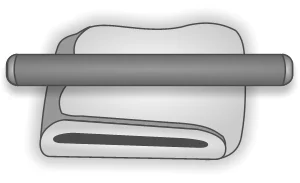
Figure No. 2 shows the shape of a Russian pie, with an attractive pinched seam.
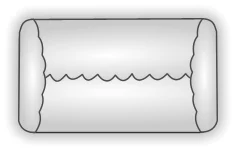
Figure No. 3 shows how to serve pancake-based little pies, rice croquettes and other croquettes with broth, shchi or borscht. For fewer diners, they may be arranged on a smaller platter in just one row.
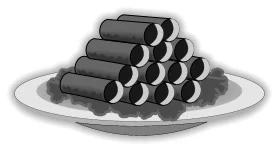
Figure No. 4 shows how to present a roasted leg of mutton and other roasted joints.
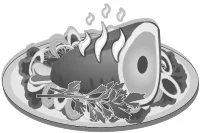
Figure No. 5 shows historical fish mayonnaise, or simply cold fish with garnish.
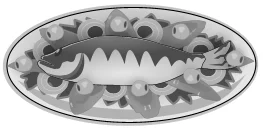
Figure No. 6 shows how to serve hot boiled or baked fish.
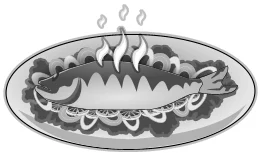
Figure No. 7 shows how to serve veal, mutton or pork cutlets with mashed potatoes, green beans and similar garnishes.
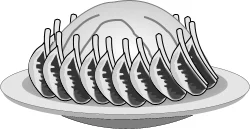
Figure No. 8 shows pancakes, Russian blini or a layered pancake pie with fillings of beef, apples or other ingredients.
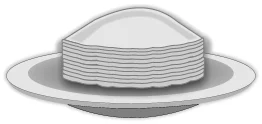
Figure No. 9 shows a platter of puffed pastries filled with beef or preserves, as well as petits choux, meringues and baked meringue sweets.
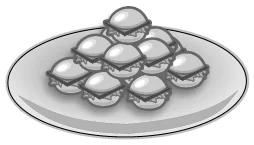
Figure No. 10 shows a ham served at Easter. The skin may be cut into scallops closer to or farther from the edge; the fat can be decorated with cloves inserted diagonally, in lengthwise lines or in a lattice. The bone is ornamented with a rosette of cut paper.
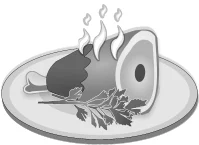
Figure No. 11 shows the presentation of Russian paskha on Easter, the Feast of Christ's Resurrection; see Section XL (Russian source).