Section LIV-II: Dining and Tea Equipment — Samovars, Serving Dishes and Table Utensils
Complete English translation of the original 1901 dining and tea equipment catalogue, including illustrations, numbered items and period prices.
(With illustrations.)
98) The newest nickel-plated tableware is very attractive: samovars, coffee pots, trays, sauté pans for forshmak, ragouts and charlottes, and frying pans of different sizes for steaks, fried eggs and other dishes.
99) A nickel-plated warming stand for dishes is both attractive and convenient. It has an oval side for a long dish and a round side for a round dish. A spirit lamp is fixed in the middle and can be turned to suit the dish. The stand holds foods best served hot, such as kolduny, vareniki, pelmeni and macaroni. Price: 4 rubles; length: 8–9 vershoks.
100) A low nickel-plated stand on very small wheels, with an ornamental openwork design. Place a serving dish on it to make it easier to move food from one person to another. Size: one-quarter of a square arshin. Price: from 2 rubles.
101) Flat wire stands of various sizes, round or oblong, for carrying hot dishes from the kitchen to the dining room. Price: 35–60 kopecks.
102) A tin tiered stand, half an arshin high, for serving crayfish at breakfast.
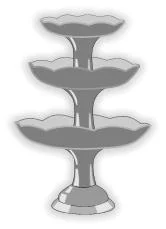
Decorate this stand with parsley or watercress and arrange the boiled crayfish over the greens.
103) A tall nickel-plated stand on a marble base, for hams. Price: 10 rubles.
104) Various coffee pots for making coffee. The author considers coffee most flavorful when made in a tinned copper or tombac pot. See the accompanying illustration. A pot one-quarter arshin high and three vershoks across at the bottom holds four large cups. First pour in boiling water until the pot is half full, up to the level of the removable tinned strainer. Insert that strainer and add six heaped teaspoons of freshly ground coffee and one teaspoon of chicory. Cover, set on the range and continue as usual. Price: from 2 rubles.
105) A crystal cheese plate with a cover.

106) An earthenware or wooden board decorated with pictures, for cutting bread and rolls. Price: 35–85 kopecks.
107) A serving fork for vegetables, such as green peas.
108) A wooden salad fork and spoon.
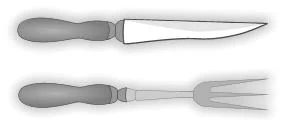
109) A knife and fork brought to the table for carving meat and game.
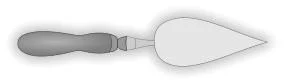
110) A silver or nickel-silver serving spatula for taking dry pastries from a platter. Price: from 2 rubles.
111) Nickel-plated scissors for clipping bunches of grapes.
112) An elongated fish-serving spoon.
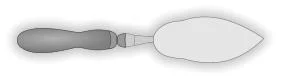
113) A round, moderately deep perforated serving spoon of silver or nickel-plated metal, for kolduny, vareniki and similar dishes.
114) A small saw for lemons, available from Kach’s shop on Nevsky Prospekt in St Petersburg. Price: 2 rubles 50 kopecks.
115) A lockable stopper for keeping opened wine bottles. Price: 40 kopecks; versions for 15 kopecks are also sold.
116) Bottle stoppers with crystal and metal heads. Price: from 15 kopecks.
117) Glass dessert spoons for caviar, preserves and similar foods. Price: from 15 kopecks.
118) Wooden butter molds, 50 kopecks each, and ridged paddles for rolling butter into balls.
119) A knife for opening oysters. Price: 10 kopecks.
120) A fork for eating oysters. Price: 1 ruble 20 kopecks.
121) Small pincers for cutting the wire on champagne bottles. Price: 3 rubles 50 kopecks.
122) A wire stand for bottles with rounded bottoms. Price: 15 kopecks.
123) Corkscrews. Price: from 15 kopecks.
124) Round earthenware coasters for bottles, coffee pots, teapots and similar vessels. Price: from 65 kopecks to 2 rubles.
125) Small glass or metal knife and fork rests. Price: 3 rubles per dozen.
126) Trays rotating on a central stem, fitted with four to nine shallow salad bowls for appetizers and another, round salad bowl for bread in the center. In shops this is called a “frushtuk.” Price: from 3 rubles 50 kopecks.
127) A similar round tabletop frushtuk for appetizers, but without a stand. Price: from 3 rubles 50 kopecks. It is also suitable for the tea table, holding prepared snacks, bread and biscuits.
128) A cruet set for vinegar, Provençal oil, mustard and pepper.
128) A carved wooden stand holding twelve bone-handled fruit knives. It is a kind of cruet stand, except that the round openings for vinegar and oil bottles are replaced with twelve straight or diagonal narrow slots holding the knives with their handles upward. Price: from 6 rubles, including knives. (The printed original repeats number 128.)
130) Similar silver stands, with ivory-handled, steel or gilded knives. Price: from 15 rubles upward.
131) Liquor cruets with small glasses in various designs: three decanters in one basket with twelve yellow or blue crystal glasses hanging around it; or one decanter on a bronze stand adorned with a garland of bronze leaves and twelve suspended small glasses; or small barrels of silver or glass, and so on.
132) Water and beer decanters in many colors and patterns, with tall matching glasses.
133) Double salad bowls for berries.
134) A wire fly cover.
135) Attractively painted flowerpots or vases for the table. Price: from 3 rubles.
136) Gift teacups made in the shape of little samovars.
137) Musical mugs for beer and other cold drinks. Price: 3 rubles.
138) Glass flytraps. A piece of black bread sprinkled with sugar, or simply fine sugar, is placed below them and soap water or tea-colored water poured into them. Price: 30 kopecks. Flies approach the sugar, then fly upward and fall into the liquid, from which they cannot escape.
139) Standard dinner and tea services with all their accessories.
140) As for knives, forks and spoons, the author prefers silver, followed by other metals only when silver-plated. She warns against a metal called “Britannia,” which she says contains harmful admixtures of copper, lead and other metals.
141) A table brush for sweeping crumbs from a table, with an oblong tin tray into which the crumbs are brushed.
142) A slicer for cutting cucumbers, cabbage for salad, radishes and similar vegetables. Price: from 40 kopecks.
143) A large slicer for preparing cabbage in quantity. Price: 6 rubles.
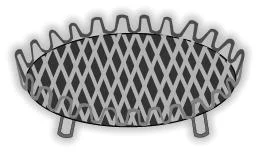
144) A metal sieve on legs, used for drying vegetables, fruit and greens in a drying oven. The printed temperatures are 40–50 degrees Réaumur for greens and up to 70 degrees Réaumur for vegetables.
145) Small spirit, gasoline and kerosene burners are very convenient, together with frying pans and saucepans of corresponding sizes.
a) A small spirit burner, price 1 ruble, is useful for quickly heating water for medicines or poultices, milk, and ladies’ hair-curling irons, among other things.
b) A gasoline burner is larger than the spirit burner. In five to ten minutes it can boil water for tea, cook eggs, boil milk, cook porridge, fry cutlets, steak or eggs, fry bread soaked in milk, heat yesterday’s pudding and even make broth. For the broth, the author suggests taking a somewhat larger quantity of the softest choice boneless beef, chopping it finely, putting it into cold water, bringing it to a boil, adding a spoonful of dried or pressed roots, simmering for five to ten minutes, salting and bringing it to a boil again.
These gasoline burners cost from 1 ruble 25 kopecks to 2 rubles 50 kopecks, depending on their size. Corresponding pots and frying pans are sold for boiling water, cooking porridge, frying steak and other uses.
To light the gasoline more quickly, the author suggests rubbing two lit matches across the openings of the slightly tilted tube until the burners ignite. (Historical description only; do not reproduce this ignition method.)
c) Kerosene cooking stoves are larger still and can be used to prepare entire dinners. Price: 1 ruble 25 kopecks to 6 rubles.
146) Wickless kerosene-gas cooking stoves, fueled with kerosene. Price: 8 rubles. Their flame is described as having the combined heat of eight burners, sufficient to melt tin.
147) Gasoline-gas cooking stoves sold under the name “Unika.” Price: 3 rubles 50 kopecks.
148) For suppers attended by a large company, small wooden tables on four legs, made in several decreasing sizes, are convenient: when pushed one inside another, they look like a single table.