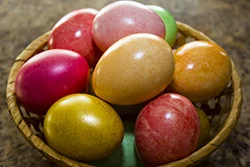
No. 3221 — Various Historical Methods for Colouring Easter Eggs
English historical translation of Molokhovets recipe No. 3221 from the 1901 Russian cookbook, retaining original methods and measures.
(a) Use scraps of coloured silk that shed their dye. Shred and mix the scraps, wash and wipe the eggs clean, then dampen and wrap in silk, adding patterned pieces cut from blue sugar paper. Cover with a rag, tie with thread, immerse in warm water, and boil for 10 minutes from the moment it begins to boil. Cool before removing the coverings.
(b) Wash and dry the eggs, wrap in rags and tie with thread. Drop ink onto the wrappings in places using a wooden stick, put into water and boil for 10 minutes once boiling. Cool before removing the cloth.
(c) For red, soak ¼ pound sandalwood dye in cold water overnight in a medium pot. Bring to a boil, add ½ lot alum, stir in the eggs and keep at the side of the stove until coloured, then boil for 10 minutes. Cool, remove, wipe with cotton moistened in olive oil and dry with a towel. The same dye bath may be used for two or three batches.
(d) Yellow is produced in the same manner by boiling eggs with onion skins or young birch leaves. For variation, dip red eggs into yellow dye and yellow eggs into red dye and bring them briefly to a boil again.
(e) The author mentions egg-colouring powder supplied with instructions by a chemical laboratory. (f) She recommends Marquet factory dyes in bright red, pink, violet, blue, yellow, green and orange.
(g) Apothecary shops and chemical laboratories sold marbled paper at 5 kopecks for an envelope of ten sheets. (h) Liquid dyes in twelve colours cost 10 kopecks per bottle.
(i) 'Mosaic Shine' for brilliant egg colours cost 20 kopecks a bottle. (j) Gold and silver egg paints cost 5 kopecks a packet. (k) Multicolour marble-effect powder cost 5 kopecks a packet.
(l) Egg varnish in twelve red shades was sold for 10 kopecks a bottle. All these commercial products came with printed instructions.